“If anything has stayed with me throughout my entire adult life—and truly deserves a place in my ‘Footsteps Through Time‘ website—it is the skills I learned and grew into: renovating older houses.
From a young age, I realised I had inherited my father’s ability to work with his hands. He was a highly skilled toolmaker and a capable woodworker, spending many hours in his home workshop. As a small boy, I followed his projects with quiet fascination, watching and absorbing more than I probably understood at the time.
He passed away from a heart attack when I was nine years old. That loss marked a turning point for our family. My mother, a housewife without formal employment skills, and my siblings and I were suddenly faced with an uncertain and difficult future.
We lived dependent on the welfare available in those years, and as a child, I had little understanding of the struggles that lay ahead. It was only later that I came to see how profoundly those early hardships shape the course of our lives.
When financial security is out of reach, we learn to value other things—practical skills, resilience, and the ability to create something from very little. For me, that path led to a lifelong connection with renovation”.
That first real attempt at renovation didn’t begin with confidence—it began with necessity.
We couldn’t afford a finished home, not even close. What we could afford was something tired, neglected, and well past its best years. To many people, it was a place to avoid. To me, it was an opportunity—though at the time, I’m not sure I fully realised what I was taking on.
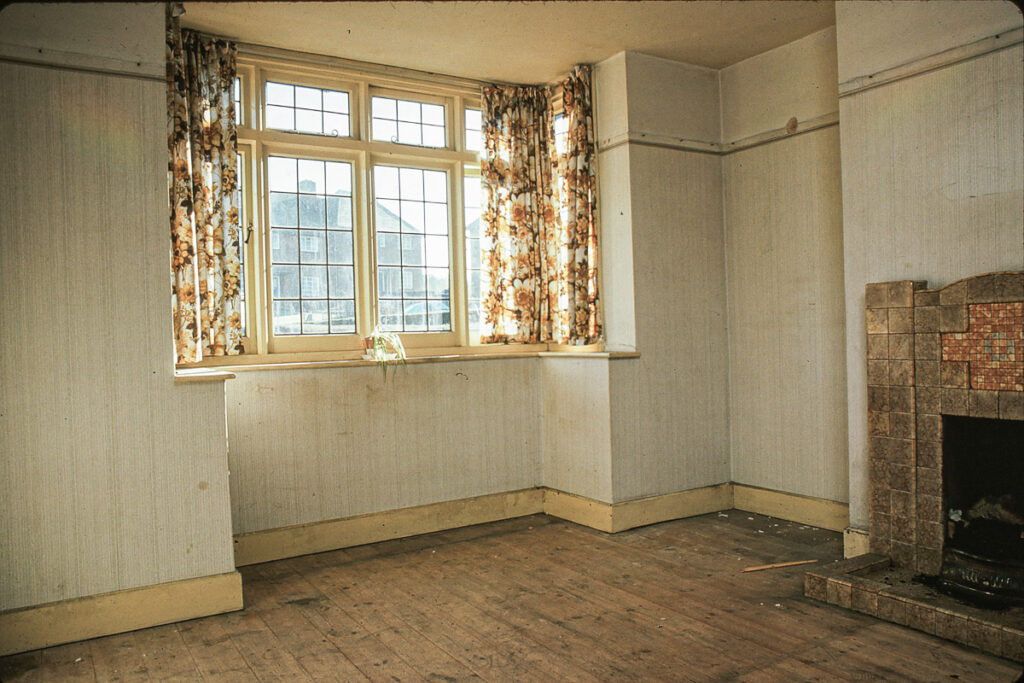
The house had seen better days. Walls were worn, fittings outdated, and almost everything carried the mark of years without proper care. But beneath all of that, I sensed something solid—something worth saving. This was my first step on that ladder of ownership of bricks and mortar.
I had no formal training, no step-by-step plan, and very few tools beyond what I could gather or improvise. What I did have was a memory of watching my father work, and a growing belief that I could figure things out as I went.
So I began.
One job led to another. A small repair uncovered a bigger problem. What I thought might take a weekend stretched into weeks, then months. There were mistakes. Cuts that didn’t quite line up, materials wasted, jobs done twice because the first attempt wasn’t good enough.
But with each setback came a lesson.
Slowly, almost without noticing it, the house began to change. And so did I.
What started as an act of necessity became something more—a quiet satisfaction in bringing something worn and forgotten back to life.
Within my circle of siblings, I had three older brothers whose skills I had yet to acquire.
The eldest, Tony, was a painter and decorator—and I had a feeling I would be calling on him when things became difficult. Colin was a contract carpenter, solid and practical in his trade. And Phil, a general foreman, seemed to carry a broad knowledge of almost everything that happened on a building site.



They were a smiling, easy-going trio of characters who, when asked, were always willing to share their time and knowledge, passed down the sibling line to this relative newcomer to their trades. I was fortunate to have them. Between them, there wasn’t much that couldn’t be done—and I knew it wouldn’t be long before I began drawing on that shared experience. The truth is, my “learning curve” began with a fair amount of asking, watching, and—if I’m honest—a bit of persistent nagging. Skills weren’t handed to me outright, but they were there to be borrowed, observed, and slowly absorbed. Everyone has to start somewhere.
When I reflect on those early, yet fairly major, changes to the house, Phil was in and out several times during my construction of the rear extension.
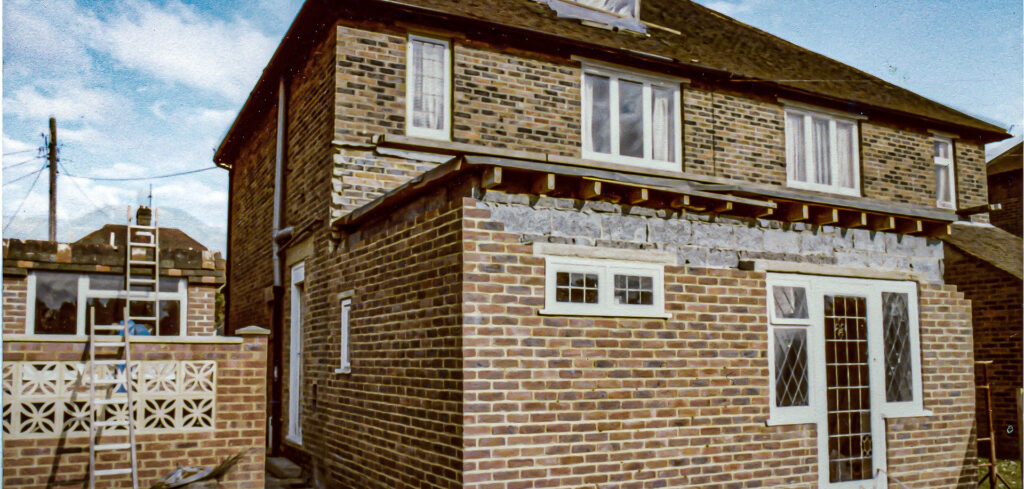
There were concrete footings and a floor slab, double brick walls, and a slightly sloping roof—all things I had ideas about and some experience with, but little real confidence in.
Details mattered. How to correctly place lintels over windows, how to approach each stage in the right order—Phil would be there, advising, explaining, and quietly guiding the process.
I listened carefully, taking it all in.
And then he would leave—placing the responsibility back in my hands—to work through the physical side of what was, for me, an advancing skill.
It was a gradual handover—from watching to doing.
Colin came into the picture a little later, when I decided to build a dormer window into the new attic bedroom I had in mind.
In my enthusiasm, I had imagined it to be a fairly simple hammer-and-saw job—cutting and measuring new rafters to rebuild what would soon become a rather large hole in the roof… or so I thought.
A short conversation or two with Colin quickly brought me back to earth, and that old adage—“think thrice”—returned to the forefront of my thinking.
He began with a simple question:
“What size window are you going to use?”
It stopped me. I thought that was a ‘last’ step.
Of course—everything followed from that one decision. The structure, the proportions, the strength of the build… it all depended on getting that first step right.
Well… of course it would. I was beginning to understand that in building, as in much else, the first decision is often the most important.
With practised ease, my brother marked and cut the rafters, then worked up through the roof lining until the sky was suddenly visible above us.
I remember thinking—I hope it doesn’t rain for a day or two.
Within a few hours, the dormer began to take on the shape we had imagined. With the flashing in place, we lifted the window from inside and eased it into position.
A perfect fit. First time.
What followed was mine to complete.
The internal work—gyprocking the walls, fitting architraves and skirting—slowly turned the space into a room. All that remained was the final decorating. And that’s where things became less straightforward. Tony had just returned from a large project and was enjoying a few days off—or so he thought.
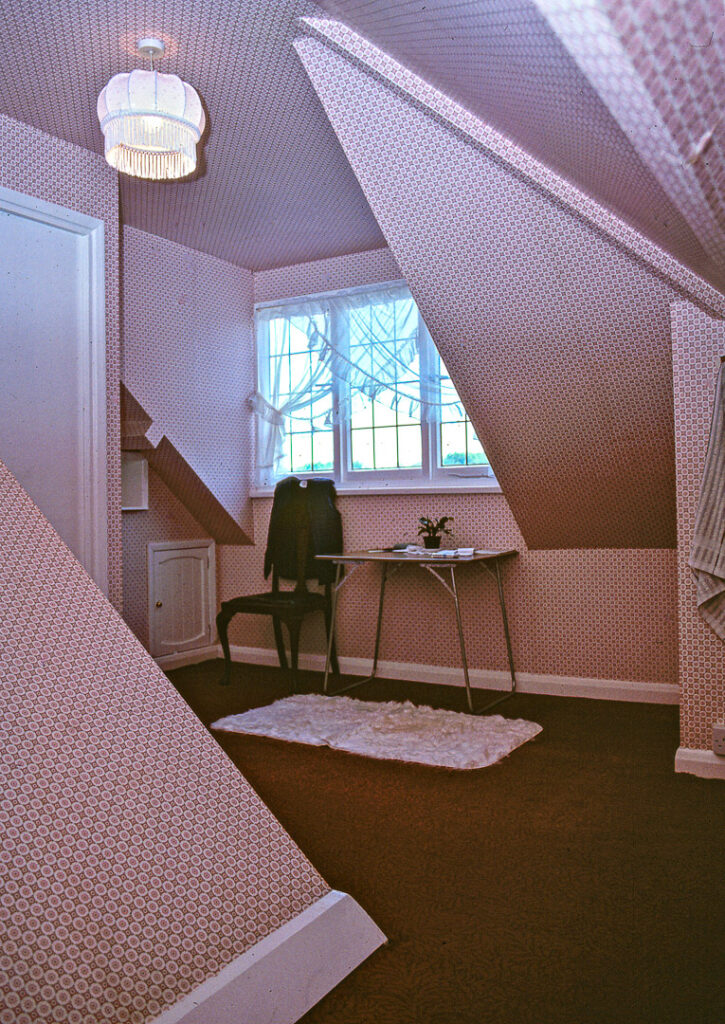
As with most roof conversions, the new bedroom was a mix of vertical, horizontal, and sharply angled surfaces. I had chosen a small-patterned wallpaper, thinking it would suit the space.
Standing there, looking at those intersecting angles, I realised I had no idea where to begin the wallpapering.
How was I going to line up a repeating pattern across all that?
I didn’t think I could tame this one.
“Tony… where are you?”
He hadn’t seen what Phil, Colin and I had done so far, but he was keen to take a look.
In no time, we were at the wallpaper shop, and I left the choice in his hands—something workable for those unruly surfaces.
Back at the house, I watched as he went to work.There was a kind of quiet precision in what he did—each strip placed, adjusted, and aligned as though it were part of a puzzle already solved in his mind. Angles that had defeated me seemed to fall into place under his hands.
A few hours later, we stepped back and looked at the result.
The room had come together.
Yes… I had, amusingly, chosen my brothers well.
Shaping what we had was, at first, a purely physical process—windows and doorways, flooring, and structural considerations. It was hammer-and-saw work, practical and demanding, where effort produced visible results.
But style and colour were an entirely different matter.
They introduced a new layer to the renovation “pot”—one that couldn’t be forced with tools or solved in a single weekend. It required patience, observation, and a willingness to learn from others who clearly had a more developed eye.
I found myself studying the work of more experienced renovators and designers, trying to understand what made a space feel right rather than simply functional. It wasn’t just about putting things together anymore—it was about balance, tone, and the subtle relationship between elements.
This side of renovating took time—hours, weeks even—of looking, reconsidering, and slowly developing a sense of what worked.
There was also an unwritten rule I came to understand as the work progressed.
No matter how personal the renovation became, you always had to keep one eye on the future. If the time came to sell, the house needed to remain within the bounds of general appeal.
That meant restraint.
Outrageous colours, overly bold choices, or anything too specific to personal taste could easily turn potential buyers away. What felt right to me might not feel right to someone else.
So there was a balance to be found—between creating a home that reflected who we were, and ensuring it remained inviting to others.
That balance wasn’t always easy—and I didn’t always get it right the first time.
It was a quiet discipline, but an important one.
I remember standing in one room, unsure what colour would bring it to life.
The walls were bare and tired, marked by years of use, and I found myself staring at them far longer than I expected. This wasn’t like replacing a window or fixing a doorway—there was no obvious answer, no clear starting point.
A dozen possibilities ran through my mind. Light or dark. Warm or cool. Safe choices or something more daring. Each option seemed right for a moment, and then just as quickly, not quite right at all.
In the end, the decision didn’t come from certainty—it came from instinct.
I chose a direction, committed to it, and lived with the result.
And that was the lesson.
Unlike the physical work, where mistakes could be measured and corrected with tools, this was something more subtle. You had to develop an eye, a sense of balance, and a willingness to trust your judgement—even when you weren’t entirely sure.
Over time, that uncertainty began to fade. What once felt like guesswork slowly became understanding. The process became progress through a muddle of many stops and starts. Of unfinished stages of work, of delays and wait times, throwing spanners into my eagerness to complete too many tasks.
I remember the many evenings Heather cooked in a half-finished kitchen—what I came to think of as Heather’s renovation-widow years.
Nothing was ever quite complete. A bench missing here, a cupboard door off there, tools pushed aside just enough to make space for a meal. It was functional, but only just.
Through it all, she carried on with a patience that I probably didn’t fully appreciate at the time.
Meals were prepared around the mess, the noise, and the constant sense that things would be better “once this part is finished”—a point that always seemed just a little further ahead.
Looking back now, I realise those moments were as much a part of the renovation as any wall I straightened or floor I laid.
Not everything was built with timber and nails. Some of it was built on patience.
“Wilderness,” according to the dictionary, is defined as “an uncultivated, uninhabited and inhospitable region—a neglected or abandoned area.”
In many ways, that description felt strangely familiar in the context of renovation.
The house itself—an old, dilapidated, semi-detached place —might easily have qualified. It had clearly been neglected for some time and was eventually sold on to its next owner, priced to hasten the process.
The seller, perhaps an investor or someone who had inherited the property, showed no signs of being a renovator. There was no sense of restoration—only release.
For me, however, it marked a beginning, the first step on that ‘ladder’.
In terms of context and timing, that first house was purchased for the princely sum of £17,500 and, two years later, sold for £34,000.
At the time, it felt like a significant achievement. Looking back, it was more than that—it was proof that the effort, the learning, and the risks taken along the way held a value beyond profit alone: a value measured in growth, experience, and confidence.
When old houses were “sold off,” it was common for carpets to be left in place—softening the overall look of each room and disguising what might lie beneath.
Removing them was another matter entirely.
What emerged were long, straight runs of floorboards, now slightly gapped with age, lined with hundreds of perpendicular nail heads. Knots, stains, and years of wear told their own story. To the untrained eye, it could appear little more than an eyesore—but to someone learning the trade, it was an early glimpse of the work ahead.
The carpet had hidden more than just the floor.
It had concealed the problems still waiting to be uncovered.
The carpet could hide those future problems. And I was only beginning to understand what I was looking at.
The walls of each room—and the second fixings such as cupboards, doors, and fireplaces—tended to tell their own story without hiding too much.
In those early days in England, wallpaper was used extensively, offering a more decorative alternative to plain paint. Whether bold and busy or small and intricate, those rolls of wallpaper were chosen from neat little samples in shop displays—samples that rarely prepared you for the full effect once they covered an entire room.
What looked charming in a small swatch could become overwhelming when stretched across a hallway or lounge. And once it was up, who was going to admit it had been the wrong choice and start all over again?
Over time, tastes began to shift. Softer pastel paint finishes began to replace heavy patterns, allowing space for light, simplicity, and other forms of wall decoration.
At the time, though, I followed what was fashionable.
Before anything new could begin, the old had to come off—and wallpaper stripping became another chore to learn… and endure.
hours of steaming, scraping, and very little progress or more layers revealing even older mistakes beneath
The learning was mine to endure, to polish, to grasp as a self-imposed apprenticeship.
The tools of the trade came gradually. Some were bought new, others second-hand—always purchased when needed, never in excess. Each one earned its place.
I often think of the wheelbarrow.
I hired it daily for what I thought would be a short job in the garden. Three weeks later, still using it daily, I was offered it at a reduced price. It seemed only logical to buy it—and it became another addition to my slowly growing arsenal.
That particular job came during a lull in our income, when time was available, but money was not.
The garden itself was a gently sloping, retired veggie patch, stretching from the back of the house to the rear boundary fence. I didn’t want a slope—I wanted something usable. Hence the wheelbarrow.
What followed were weeks of digging, shifting, and levelling. Somewhere along the way, the idea of a sunken garden took hold. It solved one problem neatly—the excavated earth could be used to build up the lower levels, shaping the space into something more deliberate —and Heather, always in the background, watching, let me experiment.
My new and rather inquisitive neighbours began to take an interest. At one point, they seemed convinced I was preparing for a swimming pool.
I let them wonder.
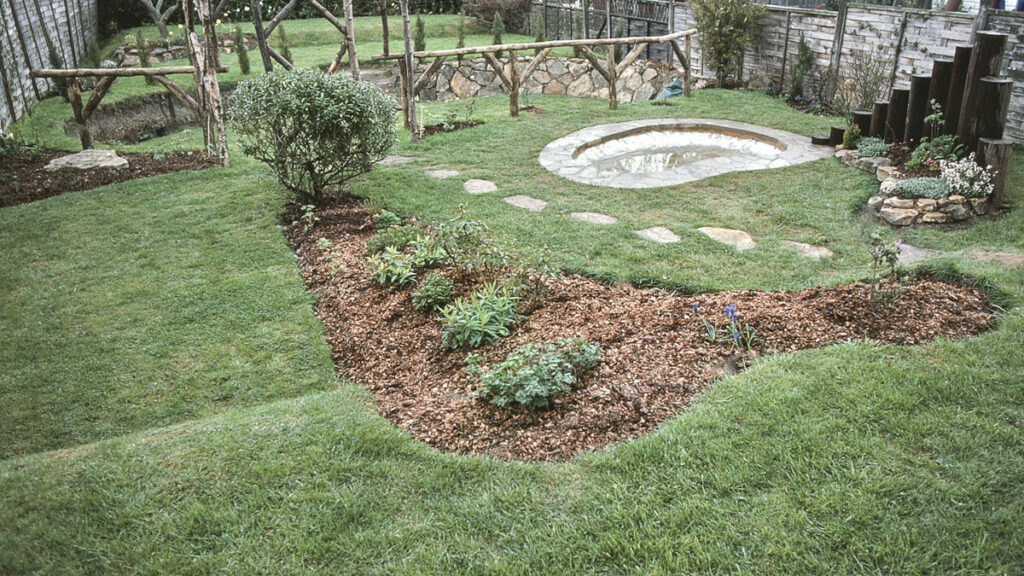
In time, the shape revealed itself—and with it, the purpose—when 500 (or thereabouts) rolls of turf finally arrived. The installation of a small pond became, in many ways, a welcome alternative to the work happening inside the house.
The rear garden and sunken area, with its turfing, bricklaying, patio work, and planting, went through several variations before arriving at the brick wall and steps.
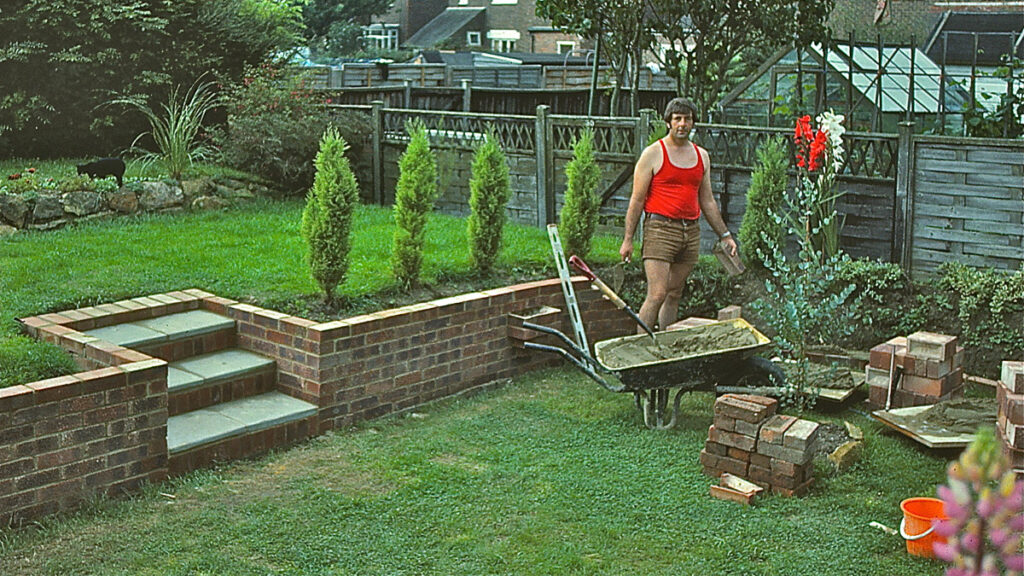
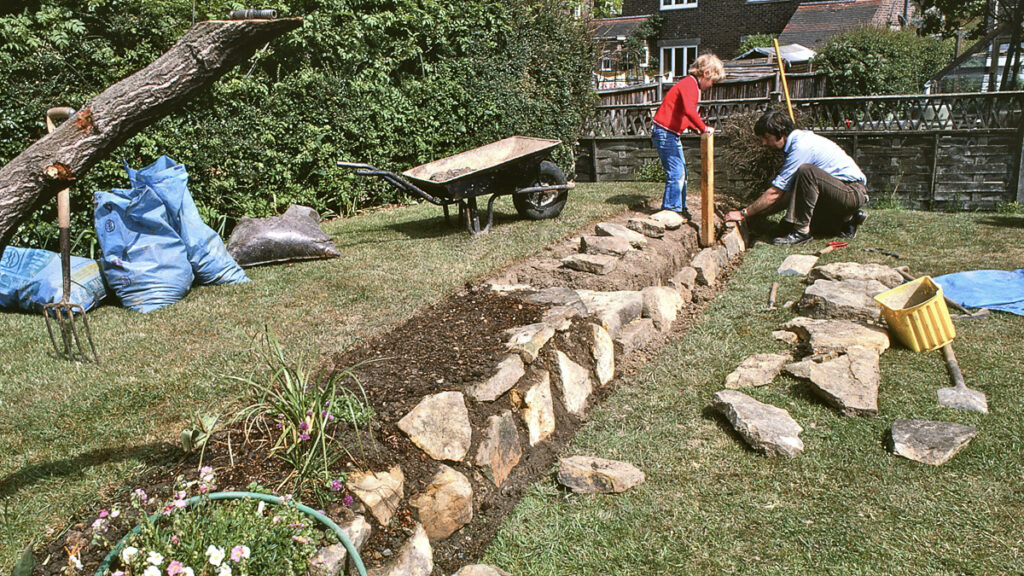
Helpers of any age were always welcome. Son Fletch was my constant shadow in all things practical.
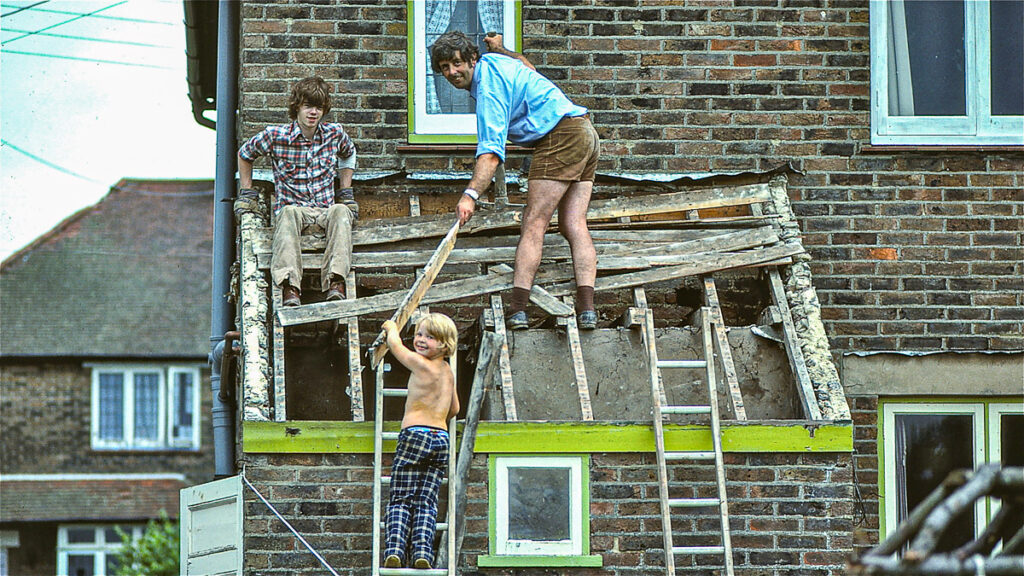
The family demolition team of Ross, Fletch and Tom is removing the old lean-to, making room for the new extension.
But inside, the real transformation was taking place.
I’ve hardly mentioned the extent of that work.
One of the existing lower bedrooms had to be reduced in size to accommodate a staircase to the new attic bedroom.
At the rear of the house, we added an extension—creating a new bathroom and a sunken dining room. With two steps down and a brick archway framing the space, the ideas that had once lived only in my head were beginning to take shape in brick and timber.
And then there was the heating.
I installed a gas-fired system to feed radiators throughout all three floors, with pipework running beneath the floorboards and managed across three separate zones. There was no one I felt inclined to call on, so it became a matter of research, persistence, and a fair amount of trial and error.
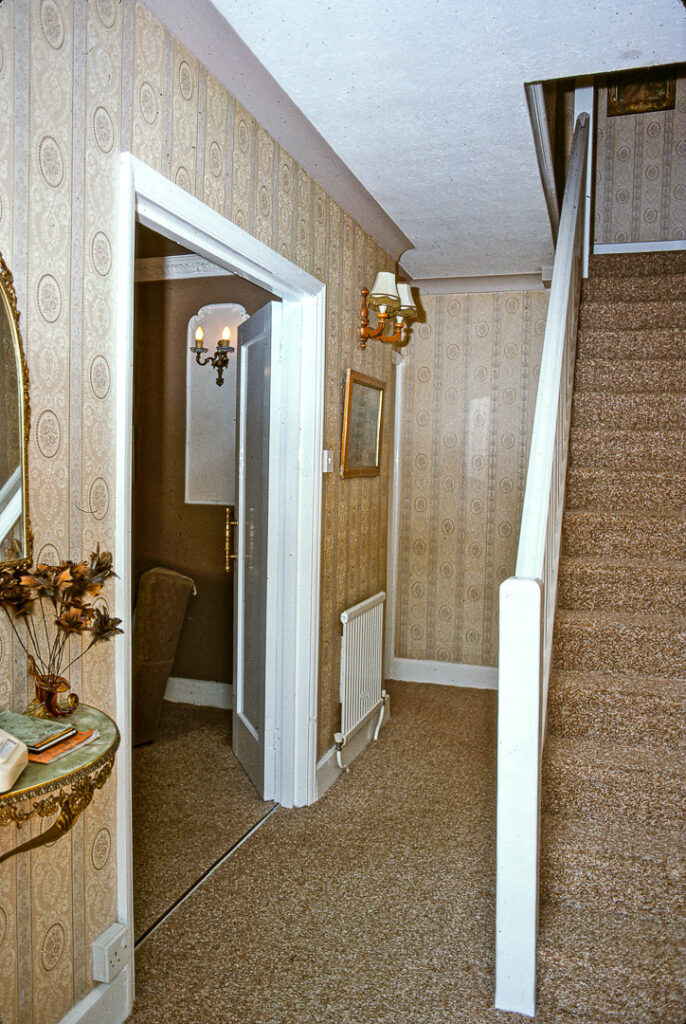
The ground-floor main hallway on the left shows one of the many central-heating radiators installed throughout the house.
By this stage, I had apparently become something of a plumber—though perhaps a rather noisy one, as I lifted and replaced floorboards throughout the house.
My older neighbour, who shared the other half of our semi-detached home, once remarked that I was a “noisy bugger.” I could only smile at his candid observation.
Many years later, on a return trip to England, I called in to see him. He recognised me immediately and said,
“Oh… you’re that noisy bugger who lived next door.”
Some things, it seems, leave a lasting impression.
Surely I had changed a little.