The Sailing Catamaran
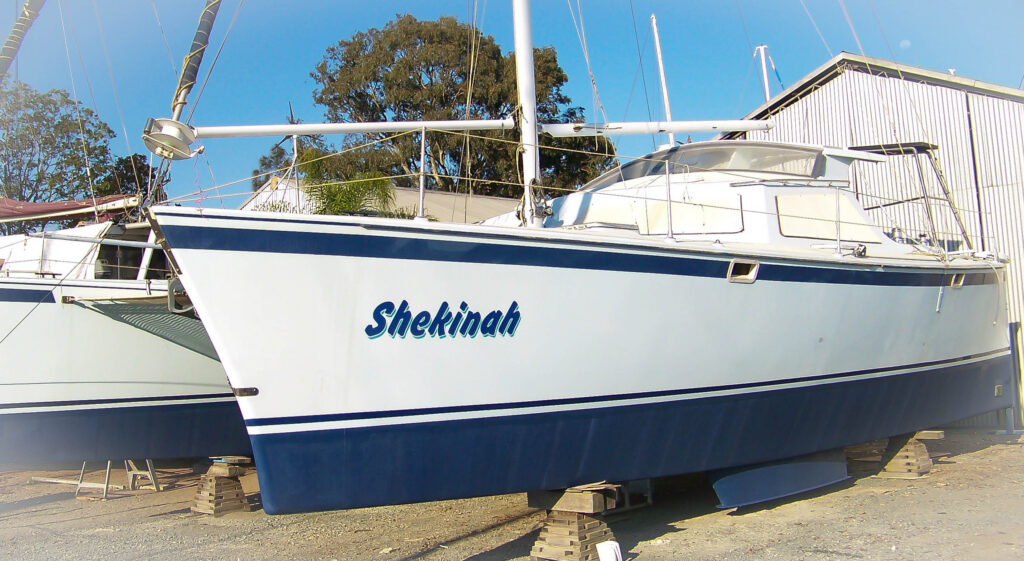
“This page is a memento of a bygone chapter in our life’s travels — a handful of images and reflections drawn from our time aboard the yacht. It’s here for fellow yachties, and anyone curious about the rhythms of life afloat: what lies beneath the surface, what makes a yacht tick, and how one might live well in small spaces, often far from shore. Enjoy.
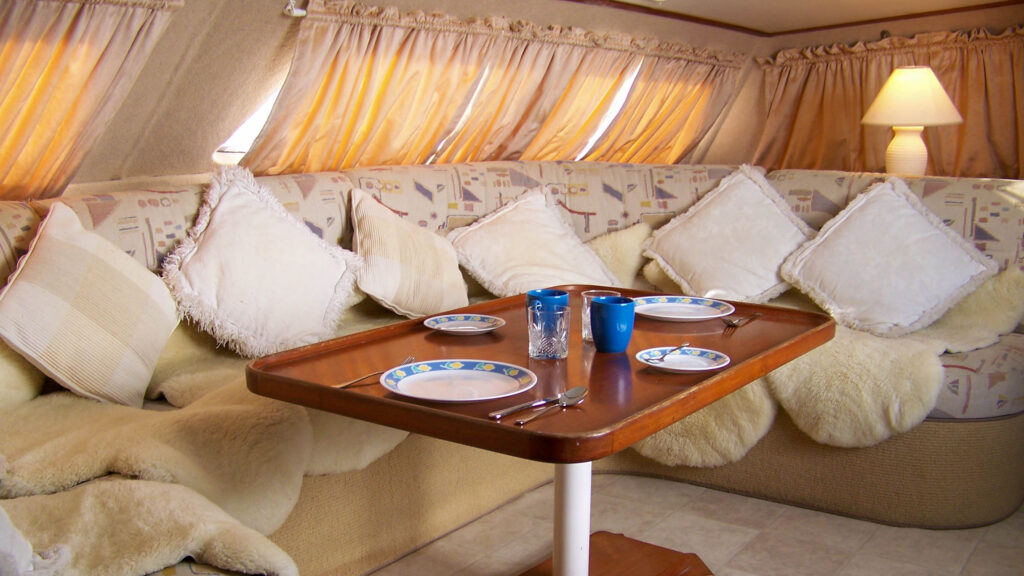
The saloon stretches across the wider midsection of both hulls.
The first thing that stands out when you step aboard this vessel is the high-quality workmanship and exceptional finish. This Hitchhiker has been meticulously built according to the designer’s plans, and is thus a well-performing and exceptionally safe cruising catamaran. The interior is beautifully finished, with creature comforts combined to create an atmosphere of home, yet within a very practical sailing layout. There is a huge amount of concealed storage for living aboard, and many buoyancy chambers are built into the structure. Having completed several Pacific Island cruises to Vanuatu and New Caledonia, this vessel is fully equipped for remote-area living aboard and includes all safety equipment. A great cruising vessel that is safe and ready to set sail.
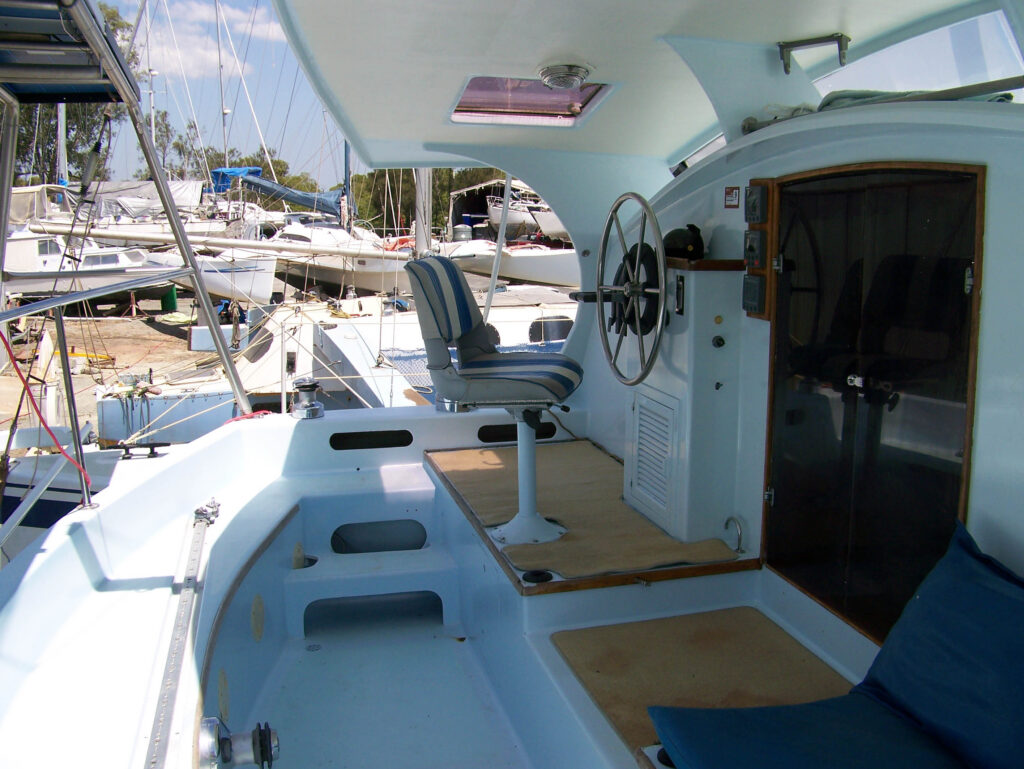
The cockpit and steering station
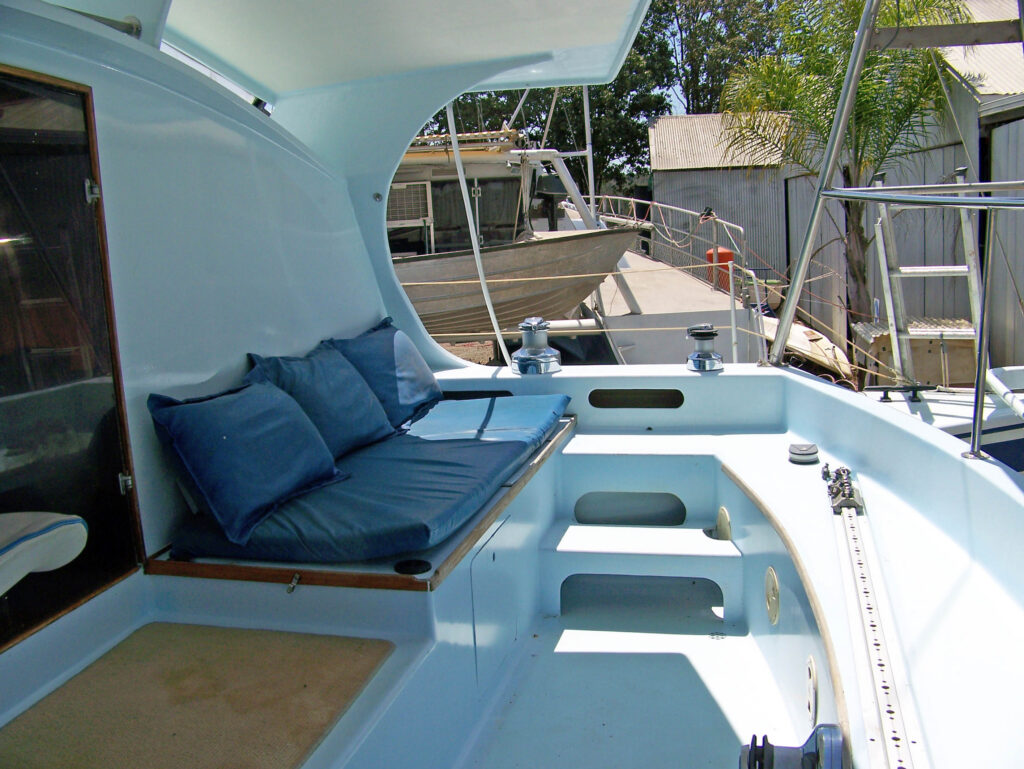
There is a pilot berth also in the cockpit
The picture below shows Shekinah’s galley, which has Gas, 240V and 12-volt facilities. The galley includes a 240V toaster, jug, microwave, and frypan, plus SS saucepans and frying pans, and a large number of kitchen utensils. The double crew cabin is located just forward of the galley.
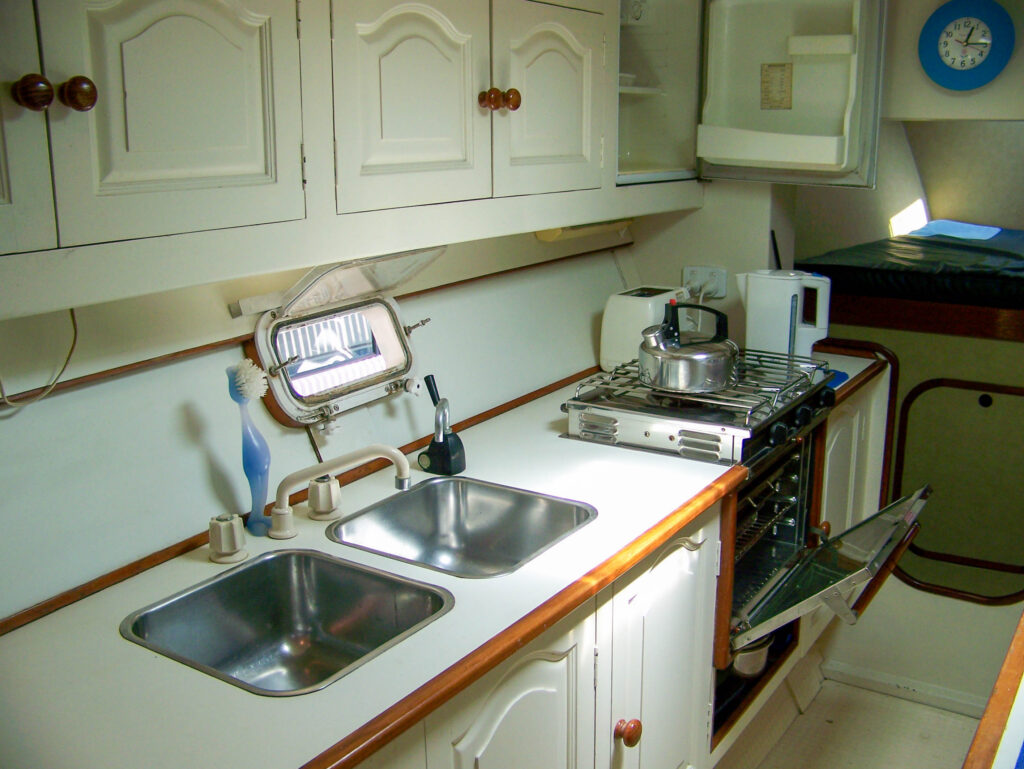
Shekinah’s fully equipped galley in the Starboard Hull
.
.
At the aft end (the rear) of each hull, there is a smaller cabin which, as pictured here on the starboard side, houses a single berth. The similar cabin on the port side was our shower and toilet or ‘Head’.
.
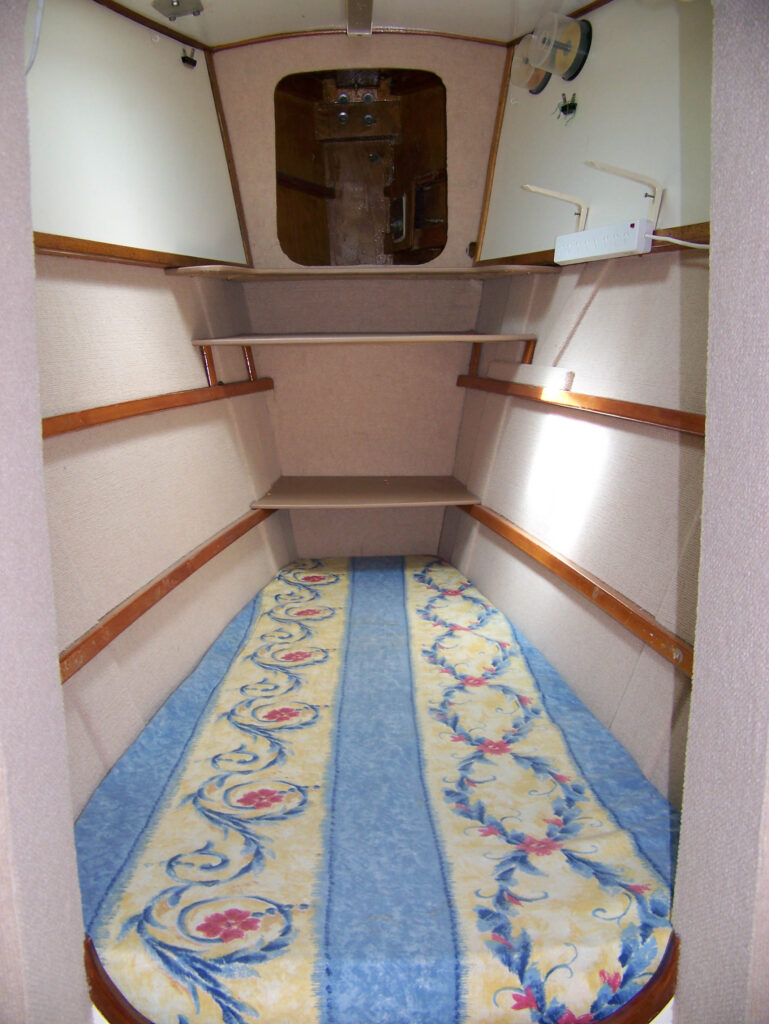
On any yacht, space is always at a premium, which means many areas are used for multiple purposes. This cabin also doubles as a computer cabin, a clothes-hanging storage area, and a large storage area under the blue mattress.
.
The heart of any seagoing yacht is its navigation station, and Shekinah has backups for just about everything. Two GPS units, three ship-to-shore radios, a high frequency modem for sending emails and a full-size chart table littered with expensive, but super accurate, charts. The Nav station is also linked to the steering and instrument station in the cockpit.
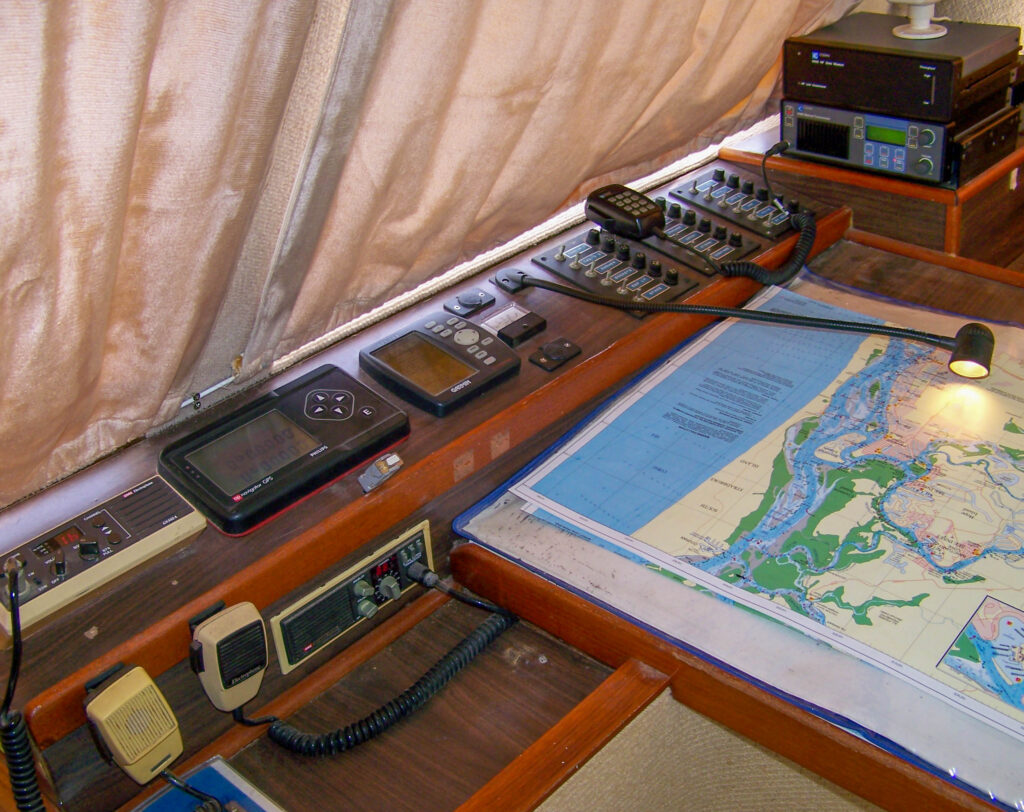
Navigation Station and chart table
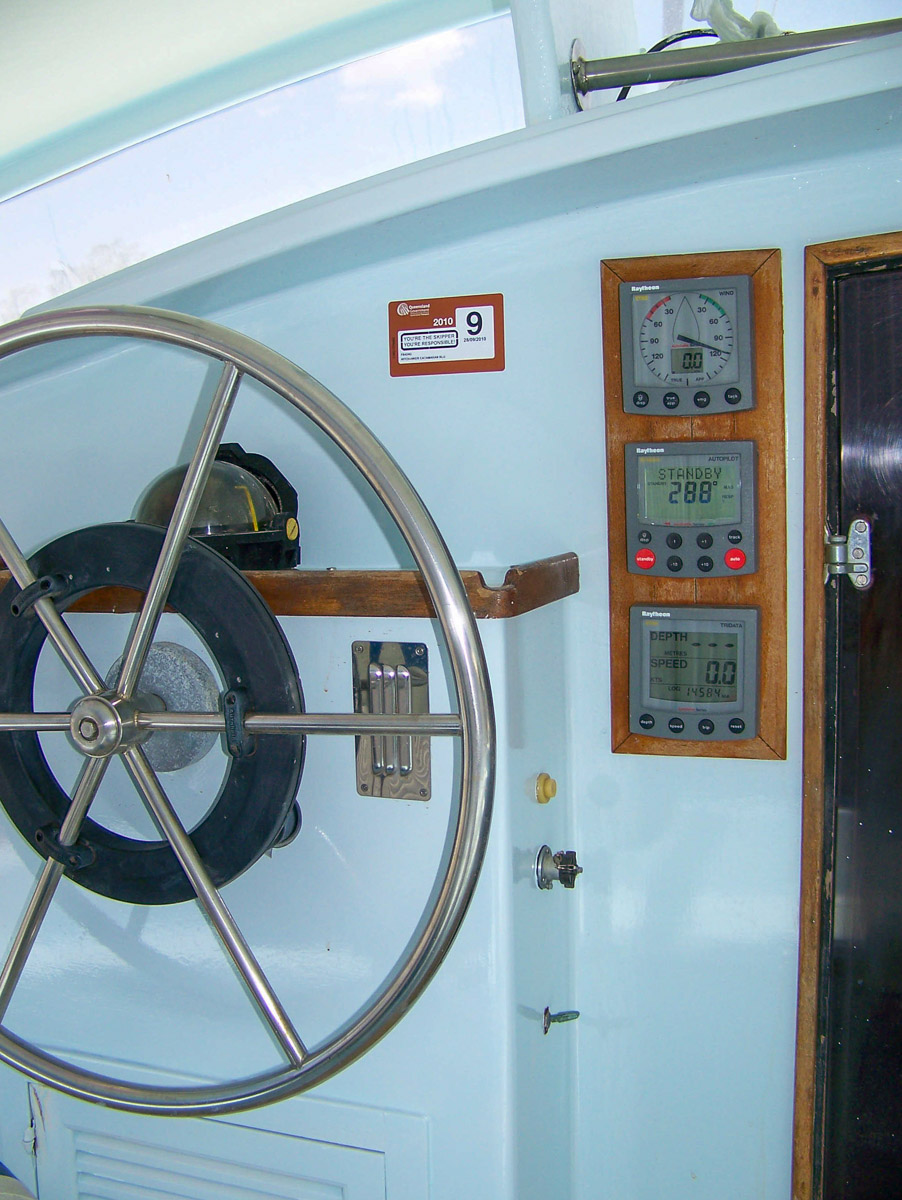
In the cockpit, the steering station has the main instrument panel for such things as boat speed, water depth, wind speed, wind direction, etc., and, of course, the autopilot, which steers the boat in a predetermined direction. Back at the navigation station, the main GPS unit also provides the autopilot with corrections for tide and drift. clever stuff!
~~~~~~~~~~~~~~~~~~~~~~~~~
“Although a little technical, within this story I have tried to offer a closer look at this living, breathing form of ocean transport — one that few people ever experience in their day-to-day lives. Words, however carefully chosen, can only suggest what such a vessel is like. Each reader is left to form their own mental picture. Photographic images remove that uncertainty. They ground the narrative in visual reality, allowing the boat, the spaces, and the sea itself to speak with clarity and honesty...I hope that together, these words and images have given you a genuine glimpse into the lived reality of this story”...Tom
~~~~~~~~~~~~~~~~~~~~~~~~~
Shekinah’s Electricals
Shekinah needs stored power – The combined elements of wind, sun and her motors are all tuned to charge her batteries.
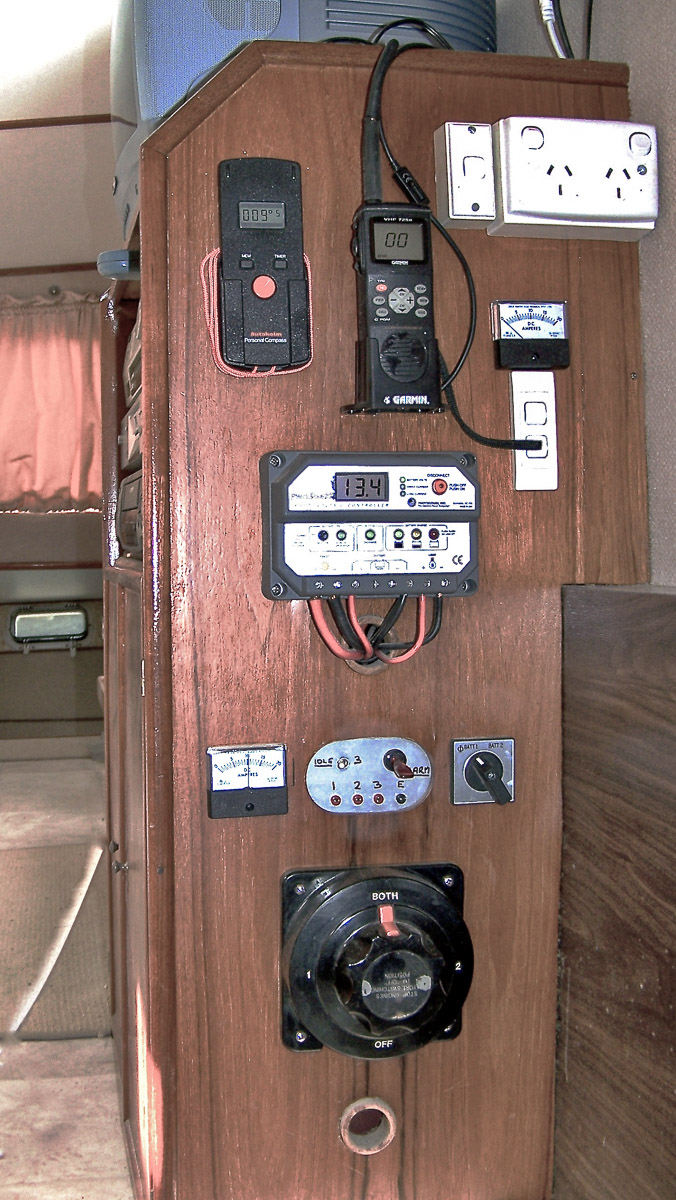
In use, two 60-watt and two 80-watt solar panels are mounted on a stainless steel Targa frame that spans the width of the boat just behind the cockpit. The two 60-watt solar panels are ganged together to provide power to charge our batteries. The two 80-watt panels are ganged to create a bank of slightly higher charging power for the batteries. and can be assigned to charge Shekinah’s two banks of four batteries. A rotary switch marked ‘batt1’ and ‘batt2’. is used to direct either the two 60-watt panels or the two 80-watt panels to charge either battery bank.
If one battery bank is running down, simply turn the rotary switch to that battery bank. ie, ‘batt 1’. In this situation, the two 80watt solar panels are diverted to charge ‘batt 1’, and the two 60-watt panels will continue to charge the other battery bank. Simply switching the rotary switch over to ‘batt 2’ will reverse the charging situation. In this way, all batteries receive a continuous charge, but you can divert the higher charge (from 2 x 80-watt solar panels) to whichever battery bank is running lower.
During periods without sun (at night or on cloudy days), the small Air Marine wind generator comes into play and charges either battery bank via two white switches. If there is no wind, battery charging can still be achieved with a small Honda 1 Kvh petrol generator supplying power (through the ‘Electrical Intake’) to the built-in battery charger. Again, that battery charging may be assigned to whichever battery bank needs the power first. The two battery banks are made up of four 6-volt, 225 AH low-maintenance, deep-cycle batteries. The four batteries are wired as two separate pairs, each in series to form two very powerful 12-volt battery banks, which is the recommended configuration for use with solar panels and wind generators. In addition to that, the best situation is Shekinah’s dual power supply (4 x solar panels/wind generator), dual power storage (2 x battery banks), a third alternative is a petrol generator to run the built-in 14 amp charger and a fourth alternative is Shekinah’s two Yamaha 9.9 HP motors, which also provide charging to each battery bank. The port motor supplies charging to Batt 2 and the Stb motor to Batt 1. Shekinah’s electrical system also incorporates the American ‘Pro Star 20’ solar charging controller (The large white unit in the middle of the picture above), which is designed to protect all parts of the system, but especially the four (very expensive) batteries from overcharging.
‘Shekinah’s Electronics’
Now we’re getting really technical (smile)
The electronic systems on Shekinah are those that provide navigation, communications, and the ship’s status.
Navigation includes;
- The Primary GPS (Global Positioning System) is the Garmin GPS 128. This is our main standalone GPS. We have also set this up with a ‘D’ sub connector, which then communicates with electronic charts in our laptop computer. The Garmin also provides a variable anchor alarm and ‘man overboard’ position indicator via a button at the steering station.
- Philips ‘AP Navigator GPS’ is a spare.
- Raymarine
- ST4000 wheel autopilot (seatalk and NMEA capable)
- ST60 Tridata (speed/depth/log)
- ST60 Wind Indicator.
- Furuno 16-mile radar with guard zone.
- Electronic hand-bearing compass
Communications Includes;
- Top-of-the-range Codan HF radio with HF Modem – this unit allows international phone connectivity through the handset, scanning multiple frequency groups, sending and receiving emails, and many other special features demanded by world military organisations. Codan is the recognised ‘Rolls-Royce’ of communications. The system is complete with an ‘E’ plate and aerial built into the port mast backstay.
- Shore-side phone system with 2 fixed phones in the galley and the bridge deck cabin. Includes all cables to connect to a marina phone (Telecom) system.
- Fixed VHF installation (GME Electrophone GX552A) plus a waterproof handheld VHF for when the crew goes ashore (Garmin submersible VHF 725e).
- Fixed 27 MHz. radio (GME Electrophone GX287A). For possible communication with small club sailing events.
Your thoughts or reflective comments are welcome and encouraged