.
.
“The following true story is an account of our time and involvement with The Republic of Vanuatu and its people, the Ni-Vanuatu.“

“The Shekinah story began in the mid-1990s, when my wife Heather and I embarked on a voluntary Mercy Ship mission to Tanna Island in southern Vanuatu. What was intended as a season of service became the foundation of a twelve-year journey that would shape the rest of our lives.
Early in that journey, we sold our home to purchase Shekinah, a 41-foot catamaran, which we extensively fitted out for remote-area sailing. Before committing to life among the islands, we undertook a 2400km Shakedown Cruise—north through the Whitsunday Islands to Bowen in North Queensland, then back to Brisbane. Over four months at sea, we learned to trust both the boat and ourselves. By the journey’s end, we were convinced that Shekinah was the right vessel for what lay ahead.
What follows is not a straight line, but the natural unfolding of one season from another.
For the next five years, Shekinah carried us throughout the eighty or so islands of Vanuatu. We sailed to many remote villages, always searching for safe anchorages and shelter from sudden weather changes. We carried small gifts for village chiefs, second-hand clothing, and basic medical and educational supplies to share with the communities we visited. Occasionally, we transported doctors, nurses, pastors, and church youth groups to the most isolated islands to provide practical care and spiritual support to people with little access to either.
Those years at sea became an apprenticeship—learning to live within a culture so profoundly different from our own, and discovering what service truly meant in daily life.
From that foundation grew the next phase of our Vanuatu journey: a move from sea to land. With the support of government ministers, local leaders, and close friends, we began to turn a long-held vision into reality. Together, we built a six-bedroom family house to accommodate parents of sick children brought to Vila hospital from the outer islands. We also built a children’s playground, a one-hundred-seat hospital chapel and a manager’s cottage.
This integrated humanitarian complex became known as The Shekinah Project—a place of rest, care, and dignity for families far from home. The heart of this story continues today.”
“Come with us as we open up a period in our lives that, for us, was profoundly exciting and deeply satisfying…”
~~~~~~~~~~~~~~~~~~~~~
Please turn on your Audio for this video
When you move past the video, please make sure to ‘Pause’ the video, or you will continue to hear the audio.
~~~~~~~~~~~~~~~~~~~~~
This is that Story…..Circa 1996.
Chapter One…The Beginning
I stirred as the first rays of Sunday morning sunlight broke through the early morning mist, found a path through a small chink in the curtains and landed on my pillow. Too bright to ignore and already too warm for comfort, I rolled over, turned on the ceiling fan and contemplated a move toward the kitchen. Coffee had been prepared the night before and just needed a flick of the percolator switch by whoever was up first. This morning was lay-in-bed time, so being first up, I gathered two cups of coffee and my latest sailing magazine and headed back to the comfort of my pillow. My wife, Heather, was unusually excited when I returned to the bedside, not so much for the coffee I brought her as for a book she had been reading for the past few days.
For myself, the 27ft Trimaran I had been building for the last year was a self-induced, single-sighted pursuit that tended to shut out anyone else’s excitement and most other chat lines. I was keen to peruse the boat-building section of my magazine, as my own boatbuilding activities were coming to a midpoint climax. A dozen or so friends coming later that day to enjoy a barbecue would also help turn the half-built hulls of my trimaran right side up. A momentous occasion after a year of cutting and shaping timber frames, stringers, and so many other very precise components of the build, which had thus far been built in an upside-down configuration.
My wife’s early morning excitement that day stemmed from the book she was reading by David Yonggi Cho, a world-class church leader based in South Korea. David, who was the author of many inspirational books, was also the head of the then-largest church in the world. Heather’s paperback copy of The Fourth Dimension, by Yonggi Cho, was a comprehensive spiritual philosophy on the power of prayer that answered so many of Heather’s own spiritual questions. She, like me with my boatbuilding magazine, was totally absorbed in her book. An hour of extra lay-in time passed us by with little conversation. Each of us consumed within our own personal readings.
As a teacher with many years of experience, Heather was also consumed by the needs of the children in her everyday school life. Over the years, she had developed a caring heart, especially for those less fortunate in our community and beyond. On each payday, Heather decided to start purchasing small items of children’s school necessities: pencils, erasers, rulers, sharpeners, and several other essentials for any child embarking on their education. Heather was thinking of the needs of village children in so many of the small island communities surrounding Australia. Over the months, as the floor space in our study became consumed by her many purchases, I had to enquire what, where, and when. Each item in her list had grown to more than 20. Several exercise books, lined or otherwise, were also needed for each child. Luckily, in Queensland, the commencement of the school year was always followed by sales of over-ordered school supplies. My question of “What, where and when?” was still unanswered until an approaching school holiday was only weeks away and was also the start of Heather’s long service leave. Dare I ask again?
One morning, during breakfast, Heather read in a local newspaper that a small ship was sailing to one of the southernmost islands of Vanuatu and was seeking Christian volunteers to help crew the vessel on its thousand-mile voyage from Newcastle, NSW, to Vanuatu. The ship, the Island Mercy, was on a humanitarian mission to bring aid to the people of Vanuatu, especially to Vanuatu’s southernmost island, Tanna. Heather’s excitement, at that time, was immense as she proclaimed the ship to be an answer to so many prayers. Several phone calls later, the wind had unexpectedly been taken out of her sails as the answer came back that they had all the volunteers they needed. For several days, that perfect answer to my question was left out of our discussions, and although the disappointment hung heavily, we soon realised, at least now, we had a focus for Heather’s school supplies.
We decided to put each set of twenty or so school requisites into a small shoe box, which we then painted in bright colours. We also put a small Christian encouragement text inside each lid. The boxes would then be presented to each child at a small island school…Somewhere.
One weekend, after finishing all the seventy or so shoe boxes, the phone rang! It was from Newcastle! Heather almost screamed, “Tom, they’ve had a cancellation, and they have one spare cabin for two people…Would we still like to go?” With hearts racing, we quickly said, “Yes, we’ll be there!”
We now had three weeks to organise ourselves and travel down to Newcastle. My building prowess locked in automatically as I thought about a crate for the shoe boxes. It would be 600 mm x 600 mm x 1200 mm long (Using all of one full sheet of plywood!). Each of the six interior sides of the crate would be painted with two coats of blackboard paint and screwed together for easy disassembly. We knew they had very few blackboards. Heather’s school, which used whiteboards almost exclusively, donated 2000 sticks of chalk, and the crate was just big enough to hold them all. As if prayer could ever be doubted, the box would also just fit into the rear of my aging Holden Commodore wagon, with the rear seats folded forward. We were ready.
Chapter Two…The Journey South
Three days before the sailing date, we left Queensland heading south to the New South Wales coastal port of Newcastle. Early that morning, friends helped me load the ‘Teacher’s Crate’ into our vehicle and waved us farewell as we set off on what would become a fairly significant, if unrealised, life-changing event in our lives.
We duly arrived at the wharf in Newcastle and were assigned to our allotted cabin. After a fairly uneventful journey, the ‘Island Mercy’ finally anchored off the North end of Tanna Island near a beautiful bay for two weeks. Each day, we volunteers were ferried ashore with the tools of our various trades. The objective of the whole trip was to build a schoolhouse, a trading post and a small medical clinic for the people of North Tanna. As a builder, I was assigned to build the trading post and, with local young Ni-Vans, had a great time building and teaching basic carpentry skills to them. Heather, as a teacher, was press-ganged into her obvious role and immediately surrounded by innumerable pikaninnis and their mamas.
Whilst we volunteers completed our allotted tasks in good time, the very close fellowship and obvious friendly demeanour from each side was very hard to ignore or forget in a reasonably timely manner. The day we sailed away from Tanna and its people was a quiet and all-encompassing time of sadness. This boatload of volunteers, to a person, wondered when they’d see their new friends again. For Heather and me, hooked as we were, that first time in Vanuatu would always be lingering just below the surface of our consciousness.
At that exciting moment of saying, “Yes, we’ll be there,” we had already made other plans for Heather’s long service leave from teaching. We had visited a holiday and travel ’Exposition’ at the Brisbane Exhibition Grounds several months earlier. During this visit, we easily succumbed to a sweet deal to join a 1-week cruise through the Strait of Malacca in Malaysia. We were to fly to Singapore, spend three nights in a hotel, then join the cruise for 1 week. This was to be our first-ever cruise, and we had looked forward to it eagerly.
In our excitement surrounding the Mercy ship trip and Heather’s Teacher’s crate, the Singapore cruise became temporarily forgotten.
It wasn’t until a few days after we had said, “Yes, we’ll be there”, that the start dates of each trip became apparent. They both started on the same day! I couldn’t believe it! We had already paid a sizeable deposit for the cruise, and we were also paying a daily fee for our cabin to help cover the Mercy ship’s trip costs, etc. I soon realised that a forfeiture of our deposit might be on our horizon. Both Heather and I really wanted the Mercy trip to happen, so this prioritising was unexpectedly being thrust upon us. It was as if ‘Someone’ was asking, “Where is your heart?”, “What do you really want to do?”
I phoned the travel company and told them of our predicament. Two days later, they called back to say they could put our departure date back by about two months, and there would be no loss of our deposit. I said thank you and put the experience down to luck, but later realised that it was so much more than luck.
After we arrived home from the Mercy trip, we had a three-week wait for the second trip, to Singapore, and the cruise. Whilst I don’t mention this with any intention of gloating over a perceived extravagance of two trips so close to each other, there was still an excitement hanging in the air over what was coming. The three days in Singapore were very interesting, and we joined the cruise with excitement.
All went well as any cruise would for those new to cruising. But it wasn’t until the last night of the cruise that an incredible coincidence was to visit us once again. On our last night on board, we were invited to the ‘Captain’s Dinner’ to which we passengers were all assigned to tables of four. Heather and I wondered who our dinner companions might be, but they were pleasant enough, and we began to enjoy each other’s company. As an aside, Heather and I had been church goers for several years and had been quite enjoying our church life. Our son Fletch was a permanent member of the Praise and Worship team, known for his exceptional guitar skills, and I had become involved in our church’s video ministry.
At the table, during our dinner, the lady said something which I hadn’t quite heard, and when asked about it, she repeated, somewhat proudly, that their son played guitar in their local church band. I was really surprised by that small revelation, but was even more surprised later in the conversation when she told us that they were going on a short-term mission trip with fellow members from their church as soon as they got back! Wow, of all the 2000 passengers on that ship, we had been put at the same table as another incredibly like-minded couple as ourselves. Chance? luck? coincidence? What stretch of the imagination was in play here when two sets of relative strangers would echo each other’s lifestyle activities so closely
I said once before that these incredible coincidences would visit us many times over the next several years… We never saw or heard from the couple again!
Chapter Three…Changes on the horizon
In the couple of years following our two trips, my boatbuilding and housebuilding energies began to wane. More and more, we dwelt on how we might step back into that newfound lifestyle of humanitarian servitude. Those thoughts were even more frustrating because of our personal desire to be totally self-reliant in that endeavour.
Our trimaran, whilst well-built and with several navigational aids, was still, at best, only a lightweight coastal-cruising recreational yacht. ‘Sea Horse’ was, as with most multihull style sailboats, fast and nimble on coastal waters. Any brewing storm or bad weather was easily avoided by running to predetermined shelter points along any nearby coastline. Longer coastal voyages were always planned with areas of shelter marked as waypoints on our navigational GPS charts. Safety at sea was then, and still is, paramount!
Sitting on her fully galvanised trailer with her classy pale blue livery, Sea Horse looked like she was ready for anything. She inspired a great deal of dreaming, especially from me, when my daily working life became tiring. Such was life. We wondered many times how we could safely put her into more fruitful service. After many discussions and stretches of our imaginations, we realised she would never fit into the life that we were planning for ourselves. Sea Horse was too small, no matter how well-built or how well-equipped. A few months later, her new owner hitched up the trailer and towed Sea Horse out of our lives. An element of sadness prevailed that day, but was soon brushed aside. We had a new plan!
Selling Sea Horse saw our bank balance become healthy again, but it wasn’t until Heather decided to retire early from teaching that our way forward became a little less opaque. Heather paid off the last few remaining instalments of our house mortgage, and we became debt-free. As with most young families, being free of all debt was a luxury we hadn’t enjoyed since wedding bells had sounded within our particular lives twenty-odd years previously.
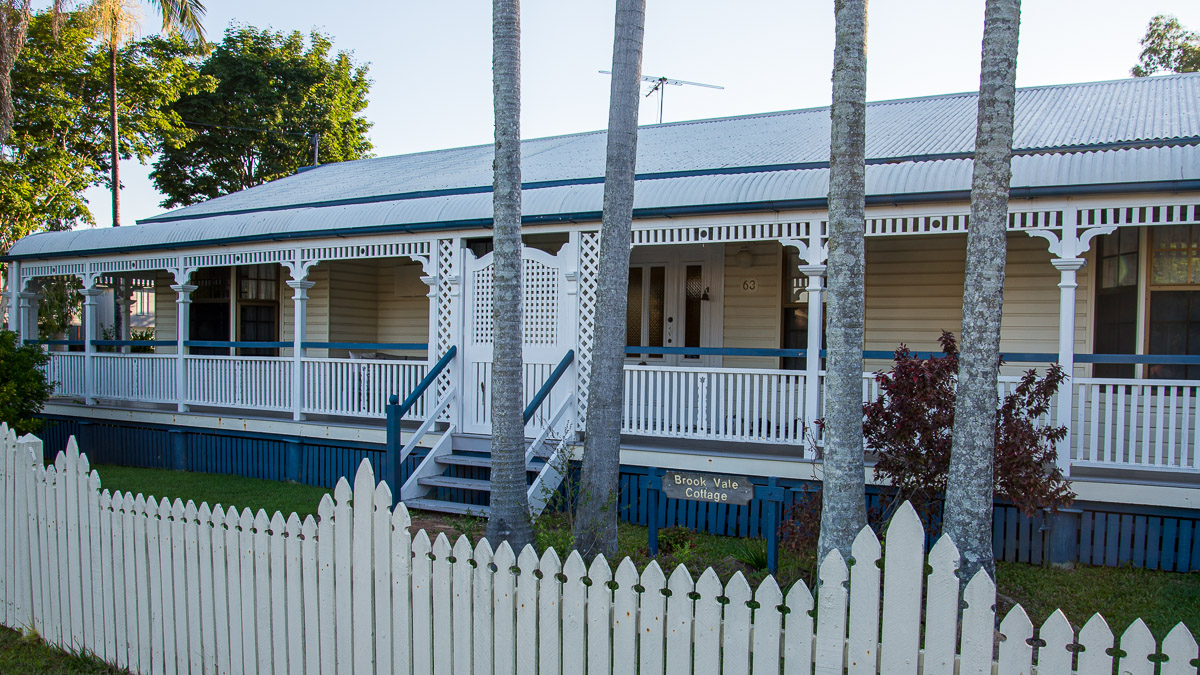
The old Queenslander-style, single-storey house I had built during an extended period of our lives was now finished. Our gardens and landscaping included several six-metre-tall paperbark tea trees. They were brought in as saplings from Heather’s family sugar plantation farmlands a few years prior and coaxed into adulthood. Other now mature shrubs and several palm trees, all growing in island-style garden beds, created a perfect setting for the period-style house. The house was nestled near a small valley through which the Kedron Brook slowly meandered, on its way to lesser altitudes of reclaimed farmland. We named the house ‘Brook Vale Cottage’.
During one of our many discussions about boats in general, I had proclaimed that we couldn’t realise our goals without a bigger boat, maybe something around 12 metres or 40 feet long!
Heather, ever practical in such matters, asked how much that might cost. I had been researching prices in yachting magazines for a while and suggested a starting price of around $150,000. As if reading my thoughts, she then asked: “How much is our house worth?” I almost choked with surprise at the question. The real estate market during the late nineties was spiralling upwards. “More than we needed”, I said quietly as if trying to hide my enthusiasm. I could only guess, with an element of hope, as to where this preamble was heading.
Heather thought for a moment. “Well then!” she said. “Why don’t we sell the house and invest in a bigger boat?” Whilst I had never been courageous enough to even hint at that insane scenario, it had dwelt on my mind for a while. I breathed slowly, not wanting to answer without some silent preamble.
“If we go down that road”, I said, “you’ll need to remember, as hard as I will try to make it work for us, it is your suggestion!” I knew we were heading towards a major shift in our lifestyle as her suggestion hit me full in the face.
Heather remained calm and fully cognisant of what she was now putting on our drawing board. “Let’s sit on it for a while and pray about it,” she said, knowing that we would surely receive some word or sign of confirmation for such a proposal.
I didn’t argue. Heather was usually correct!
.
.
Chapter Four…His Timing
Now the questions began coming in too fast! Where do we live if we sell the house? How long will be the interim between selling the house and finding a suitable Yacht? How long does a yacht inspection and purchase take? Will our adult son find alternative accommodation after years of living with us?
What about our Pyrenean Mountain dog, Rudi? Heather said once again, “Let’s sit on it for a while and pray about it”.
As with the ‘Teacher’s Box’ scenario, at least now, the pieces of a very rough plan were beginning to fall into place! We were both in agreement that we should not invite in any, albeit well-meaning, criticism, by revealing our thought processes…just yet! We were both very realistic!
Although Brook Vale Cottage was theoretically finished and we were residing therein, we still needed to prepare the house for inspection by potential buyers! We prepared a to-do list of minor repairs, small unfinished items, and tidy-up areas of builder’s leftovers, etc. Yes, I was the builder, and yes, small items occasionally got left out in the rush to move through the complex process of building a period-style home. Now was the time to finally complete those leftovers! A time when honesty and diligence would make ‘Finished’ a meaningful expression.
Four weeks later, with ladders, paintbrushes and other ‘tools of the trade’ finally out of sight, Brook Vale Cottage was now ready for market.
Meanwhile, our adult son had been kicking his heels, trying to find alternative accommodation, and, in the end, we found a small townhouse for him with only days to spare. He would take our dog Rudi with him. They had both been very comfortable with mum and dad!
We decided to rent a shipping container as a space to store our furniture and belongings, and, at the last minute, church friends offered us a small plot on their acreage to store the container. We laid two concrete bearers on which to set the container to keep it off the ground and dry.
With a changeover process now firmly established, we invited a couple of favoured real estate agents to give our house some consideration re value and saleability
At that time of year, with a fairly quiet housing market, we had no anticipation of the lightning pace we would encounter once the house was presented to the market. The house attracted a buyer in the remarkably short time of three days, set a record price for the area and the contract settled in one month! We felt almost overwhelmed as we tried in vain to keep up with the process.
Heather just smiled as I tried to adjust to the pace and plot our way forward.
‘His Time’ would take on a special meaning over the next ten years, as time and again we would use it to explain too many coincidences that we were unable to comprehend!
During that contractual period, we made many hurried return trips to the container’s new site and soon had most of our furniture and belongings neatly stacked up to the container’s ceiling. In packing the container, things we didn’t need went right to the back, stored in packing boxes! Furniture was placed on both sides of the container to create a central walkway. Things we might need to access occasionally were stored nearer to the doors. A good thought process that was never very efficient or necessary.
When we set up the container on its blocks, we made sure the floor sloped slightly toward the front to allow any water ingress to drain.
Chapter Five…A Floating Home
Throughout the run-up to the selling of the house, we had feverishly researched vessels for sale. We had decided on a catamaran for its load-carrying capacity, fast sailing, and our own general admiration for multihull sailboats. Our research involved many marina visits across Queensland, as well as sailing magazines and newspaper advertisements.
Google at that time was still in its infancy, and online research in the mid 1990s was only just beginning.
Two or three yachts attracted us, but came and went in a continuing spiral of disappointment. One such ad, for a 41ft catamaran down on the Gold Coast, looked very suitable and we arranged a test sail. The cat, named Felix, proved suitable, was very well built and was in our price range. With sleeping accommodation for five and a comfortable, stylish interior, we made an offer, it was counter-offered, and we settled!
Yes, we were excited!
We secured a marina berth for our new catamaran at Queensland’s Newport Waterways Marina, in Redcliffe, Brisbane.
One at a time, those ‘stepping stones’ toward this new life passed under our feet, but always with a seemingly unexpected urgency of pace.
I engaged the assistance of a close friend from our trimaran sailing days to crew for me as we prepared to bring the catamaran up from the Gold Coast in Queensland to our new marina berth. Although the trip was mostly inland waterways, I needed a little confidence boost, and Mike, who had sailed those waters most of his adult life, was a willing participant.
At forty-one feet long and twenty-six feet wide, our new home was certainly not a small vessel; out on the ocean, she was just that! A tiny cork bobbing on the vastness and unpredictability of the oceans of our journeys. To give a sense of size, I used to tell friends (truthfully), with a smile, that Shekinah was as wide as three buses! I had spent the last couple of years clambering in and out of Sea Horse, which at less than nine metres was so much smaller.
This new catamaran was so much bigger to me. Each of the two hulls held a forward double bunk with an aft cabin on the port side, which was the ‘head’ or toilet and shower, whilst on the opposite, starboard side, was a single bunk cabin with a storage area. The main space, or widest middle section, of each hull was used as the galley or kitchen on the starboard side, and a dressing room with a vanity area on the port side. The bridge deck cabin, which spanned the two hulls and was sometimes called the ‘saloon,’ was the main living and dining area but also housed the navigation station, with electronic instruments, charts, and HF and VHF radio installations.
Outside, in the cockpit area, close to our steering wheel, a compass and three separate electronic instruments would give us wind direction and strength, the depth of water under the hulls, and our autopilot self-steering controls.
On our charts, predetermined ‘waypoints’ are positions at which we would change direction, perhaps around obstacles or islands. It was the autopilot’s job to carry us on each leg of a given journey automatically. The autopilot, with the aid of our electronic charting computer, would draw an imaginary line toward our next waypoint and steer the boat along that line. We human ‘passengers’ just had to determine, or plot, those waypoints into the system, respond to the sailing conditions via sail changes, and of course keep twenty-four-hour watches, scanning our horizons for other ships and possible obstacles.
So Felix the cat, now re-named Shekinah, became our home. We had some modifications in mind, especially to the cockpit, which at that time was an open-air affair with just a canvas awning to protect us from the wind and rain, but not so much protection from the Queensland sun!
Radar was also a future addition, as was a four-man life raft. For communications, we would install a Codan ship-to-shore High-Frequency Radio, complete with an HF modem, to receive emails and weather forecasts. As we settled into our new floating home, the realisation of the life ahead of us began to take hold! That life now needed some semblance of order and maturity as the job of downsizing our living space from Brook Vale Cottage to such a relatively small yacht became necessary. Prioritising so many jobs into immediate and less important tasks was made easier by having already travelled down the road of boatbuilding and fit-out.
Money for some expensive items was still available from the house sale, even as I considered that somewhat amusing acronym ‘BOAT’, which, as every boat owner becomes aware of during refits, means Break Out Another Thousand!
Items like Radar, a Life-raft, HF Radio, etc., were all needing multiples of BOAT!
Fortunately, I could order these items incrementally while working on the many other, less expensive tasks on our to-do list. I also had to remember that I had taken early retirement, as part of this process! Finances would inevitably dwindle as I started down that new road of financial awareness and cost accounting for every item I needed!
A wiser individual than I once reflected that a boat was a hole in the water into which an owner would keep throwing money! Not so unrealistic!
One major task, as we were in the middle of a hot Queensland summer, was to design and fabricate a new roof and rainwater collection system to cover the cockpit area, which was around six metres wide and two metres deep.
I learned very quickly to appreciate my house- and boat-building skills, which would come to the fore many more times in this new venture than I anticipated!
My next realisation also came quickly, missing the home we had just sold with its spacious workshop and ample undercover space for larger projects!
Where could I construct my new roof?
Fortunately, another friend from church, who was also a racing monohull sailor and a house builder, came to my rescue! John, a church elder, offered me a covered area in his builder’s yard for as long as it would take to build my new roof. John also became another pair of hands during that build. Life was good!
Design was all-important for style and construction, so I resorted to my favourite computer CAD program, using a handful of measurements and my recent experience with epoxy glue and Cedar Strip planking techniques.
I’m sorry for getting a bit technical again…
The roof would resemble a Delta wing, curving across the six-metre span of the bridge deck cabin roof. I would raise it above the lower roof by about 450 mm, then install a clear, solid plastic, sloping, wind-deflecting window toward the front. A long, sweeping curve at its aft end would reflect the cockpit space it would shelter. I designed four curved support webs for strength and to lend the roof a slightly futuristic style.
Cedar strip planking, in this case, was the process of epoxy gluing around two hundred 40 mm x 25 mm x 2.5 mtr long western red cedar strips over two curved bearers, which would replicate the curve of the roof of the bridge deck cabin. Once cured and sanded to remove glue dribbles and unevenness, the wing would be trimmed to the final shape and required dimensions. The addition of a 100 mm-thick perpendicular cedar strip around the edge would provide stiffness and strength to the structure and create a rain-collecting surface on top.
Once completed, I fitted two drain spouts, one each in the lower, side corners, for the water collection. Then, 18-mm clear nylon tubes would carry the rainwater to the filler caps of the two built-in water tanks. We would need to allow the rain to first wash the roof of dust and salt spray before directing the clean water into our tanks, often tasting the water for salt before directing the flow into the tanks!
On the underneath or ‘ceiling’ side of the panel, I routed channels for the electrical wiring of two cockpit lights. With all this completed, there remained just the final sheathing of all the surfaces with two layers of fibreglass and epoxy resin. The finished sandwich of lightweight cedar between two skins of super-strong epoxy fibreglass created a structure that could withstand a person walking on the roof. This last action would be necessary during sail changes and mainsail reefing activities.
The new roof, in its final position, created an unforeseen spatial problem. During close-quarters manoeuvring, I couldn’t see the area immediately in front of the boat… that visibility was essential when coming into port or docking. The sitting area at the helm or steering wheel had comfortable headroom, but I needed to stand up when docking.
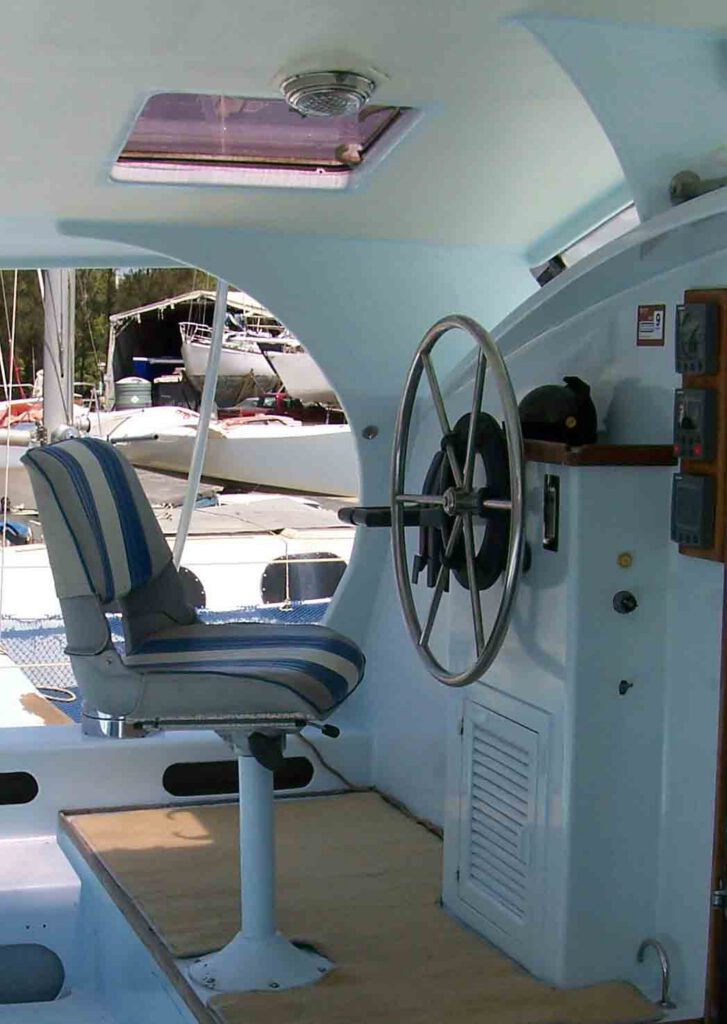
I installed a 500 x 500 mm aluminium-and-plexiglass hatch in the new roof. This enabled standing at the helm, with one’s head protruding through the hatch, allowing clear observation across the long forward section of the boat. Steering and motor controls are still reachable whilst standing up
Thinking outside the box and in advance of every possible scenario leads to many smart moves for our sailing life!
Another fairly big problem with offshore sailing was having enough electrical power to run our electronics, navigation lights, and the constant demands of the fridge freezer on a 12-volt electrical system. Four big batteries had enough capacity for the whole boat, but as we drew power from them, we needed to recharge them continuously to replace the energy.
As with most yachtsmen, we would rely on the elements to provide ongoing electrical power through a wind generator and four 500-watt solar panels.
At night, when we needed the most power, the sun was unavailable, and the wind was mostly quiet, too! We bought a small Honda 1 kVA generator to supplement the available charging from our two Yamaha outboard engines. Slowly but ever surely, we brought the boat up to our required specifications.
The picture at right is the control console for charging the two pairs of batteries, which were wired as bank 1 and bank 2.
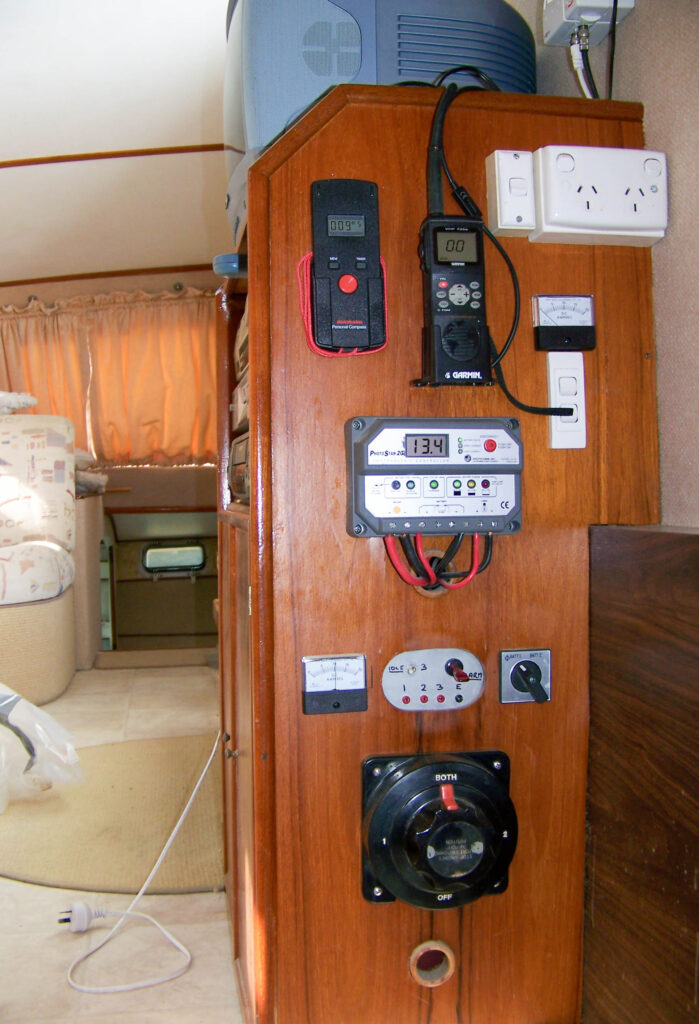
We were able to direct each of the four charging sources (Wind generator, 4 x solar panels, outboard motors and the petrol generator) to whichever battery bank needed the most charging first. The idea was to use one battery bank while the other was recharging, then swap them over with the flick of a switch.
Many thanks for this setup go to my Canadian electrical engineer and Vanuatu sailing companion, Bob.
.
.
Chapter Six…So Many Adjustments
All the while, as I was adjusting to my new confines and busying myself with a seemingly endless list of alterations and upgrades to the boat, Heather was also adjusting to downsizing from a four-bedroom, two-bathroom house to living on a boat in a marina!
I imagined insanity just around the next corner as she smilingly adjusted to living within a system where most luxuries and excesses of space had become distant memories. Cramped cupboards, an absolute minimum of crockery and cutlery, washing up after every meal, weekly visits to a laundromat and a multitude of other inconveniences would have been sheer hell on earth for a lesser woman!
I often wondered if her ‘bravado’ might be a cover for her true feelings as she whispered that discussion-closing Aussie expression, “She’ll be right!”
As I thought about her problems, I knew she was also aware of how I, too, was out of my element with all this adjusting!
She just took it all in her usual stride.
Heather, as the 3rd daughter of a Queensland sugar plantation owner, had an unswerving ability to cope with any hand of cards that might come her way. That ability would make demands of her on a scale which, at that time and to me, was unthinkable! Having worked as a teacher all of her adult life and now in a position of relative comfort, this was certainly a new, backward-stepping beginning that both of us had chosen.
As retirement from our working lives made space for our proposed future, we began planning for an aptly titled ‘Shakedown Cruise’ which would take us coastal hopping from Brisbane, north through the Whitsunday Islands and on up to Bowen in North Queensland. A voyage of around twelve hundred kms, and then returning from whence we came. This would test our ability to search out anchorages along the way, subject our navigation skills to negotiating the many shallows on our charts, and, of course, to refine our use of the wind on a primarily wind-dependent form of transport!
The many islands of the Whitsundays (Seen on the chart at right) would also replicate, to some extent, the eighty or so islands and anchorages of the Vanuatu Archipelago and also New Caledonia, which was en route.
Noumea, in New Caledonia, is a yachtsperson’s paradise with its crystal clear lagoon anchorages and barrier reef system providing a world-class sailing venue.
Bowen was also of special interest to us as an AOG church that was providing daily HF radio scheduled calls (‘skeds’) for yachts visiting Vanuatu. Coastlands Ministry provided twice daily scheduled radio calls to provide us with expected weather analysis for the whole of the area in which we would be sailing. Yachts would also update their passage progress on those twice-daily schedules, back to Coastlands. Also, an engineer there had offered to assist us with welding a stainless steel tubular support frame, or Targa, on which to mount our four 500-watt solar panels and a wind generator!
Many jobs, in the guise of upgrades and minor alterations, would come and go in the first year or two of vessel ownership. As we strove to understand our relationship with this new lifestyle, some things were a little unusual to our established land-based way of thinking or doing things. A shift in perspective was needed before we could settle in totally and declare that our metamorphosis was complete.
I remained convinced that the shakedown cruise was an effective yet subtle way to force us to come to terms with this new, very nomadic, ocean-based lifestyle.
Land-based life is so easy: if you run out of anything, break something, or get sick, it’s normal to hop in the car, drive to the shops, and buy whatever is needed. No planning or preparation for those eventualities was ever really necessary.
It’s a different scenario when you’re three or four days into an ocean crossing or in some remote island environment where shops just don’t exist.
Plan a month-long grocery list without forgetting anything. Plan exactly where you’ll store perishables (a small fridge/freezer) and non-perishables (how much locker space do you have)? If something breaks or is lost overboard, do you have the most obvious spares? Fuses, lightbulbs, flashlights, etc.
Even worse, is one prepared for man overboard situations or navigation breakdowns. Is the crew familiar and able to cope with emergencies if the skipper is incapacitated?
All very real situations that one might not need to be prepared for in a land-based lifestyle.
Our planning for this first cruise was to be a lesson in learning, a practice, if you will, but with the comfort of knowing that Australia, at this particular time, was no more than a couple of days away. Always within easy reach, via VHF radio, of the many Coastguard facilities along every inhabited stretch of the Australian coast.
All competent yachtsmen on a coastal cruise are expected to call up whichever coastguard station in whose waters they are sailing, to announce their arrival and again their departure from said waters. As you continue along the coast, you check in and out with each coastguard region.
Good manners, sensible behaviour and total positional awareness and safety.
.
.
Chapter Seven…Test Cruise Whitsunday Islands
I contacted several sailing friends about our proposed trip to Bowen and suggested they might like to sail part of the way, then fly or bus home from wherever. Knowing that most of our friends were still within their working lives, I was not too hopeful; if you don’t ask, you don’t get! Once again, my sailing friend Mike said he would come, and he asked if he could also bring his wife, Chris. Of course, that was a no-brainer, as Chris is also a very competent sailor
So we left Brisbane on a hot and humid spring day with not a cloud in the sky and only a light Southerly wind pushing us from behind. With four of us now on board, Mike and I had plotted a course on the computerised navigation system, which we were following. We sailed north from Scarborough, through the many shallows and then up around the eastern side of Bribie Island, past the township of Woorim. Just miles of white sandy beaches and low scrubby bushland of the island. It was pleasant sailing for sure.
We passed the inlet to Coochin Creek and on up past Currimundi to turn to port around Point Cartwright Lighthouse. That lighthouse was also at the entrance to the Mooloolah River, where we would spend our first night at anchor. Just before we entered the river, we dropped our sails and motored into the anchorage to a spot just outside the navigation fairway. A quick going astern to dig our anchor in, and our first short leg was completed just on twilight and just in time for coffees all round.
Mike and Chris had taken a week off work to join Shekinah, so it was imperative to keep moving and not waste time. As a sailing yacht travelling northwards, we also had to contend with the East Australian Current, which flows southwards from the Whitsundays until it breaks away from the Australian coast around Sydney, then turns easterly towards Peru in South America. That current is also stronger as you move further away from the coast
That current, made famous in the movie Finding Nemo, had amusing fishy characters who would hitch rides on the current for thousands of miles. In truth, the behaviour of those fictitious turtles (Australian Loggerhead Turtles) is not so far from the truth, according to Australian and Peruvian researchers.
As yachtsmen, we needed to stay within a mile of the coast of Australia to stay outside of the stronger main current.
Early in the year can flow at up to 4 knots. However, that will be great for coming home, though! We’ll hitch a ride with the loggerheads as well!
On day two, we left Mooloolaba just after high tide as the tide was running in our favour. Point Cartwright Lighthouse was soon behind us as we headed north again. This time towards Noosa, one of our most favourite land-based holiday destinations. On the way, we passed close to Coolum Beach, where Heather had grown up and which was her nearest beach to home. She stood watching, perhaps deep in thought, as she had never seen those beaches from this ocean perspective.
A little further on, as we were passing Woodgate, just south of Bundaberg, we got a call from our son and daughter-in-law, who were there for the day with the grandkids. We decided to head into shore there and quickly put our dinghy over the side. After a quick row ashore and with Mike holding the ‘reins’ to keep Shekinah stationary, it was a quick hello, hugs all round and a slightly hurried departure as the tide was falling.
As the next few days passed by, we called into various new anchorages, including the aptly named Yellow Patch on Curtis Island, where we accidentally bumped into Australia (ran aground) and then on to South Molle Island, which has a large family resort near the anchorage. Another sand island, which we anchored at, caused some mayhem. In the lee of that island (sheltered side), the ocean was glassy calm, so, after we anchored, Mike and Chris took to our dinghy and rowed ashore to look around. Half an hour later, amid shouts from the hapless couple, our dinghy floated past Shekinah, driven by a very light breeze. Mike had forgotten to put out the dinghy’s anchor on the shore, so the slowly rising tide decided to ‘steal’ our little orange inflatable. With much humorous cajoling, we quickly pulled up Shekinah’s anchor, put our boarding ladder over the side and motored over to ‘rescue’ Mike and Chris. They quickly climbed aboard as I turned our bows around to give chase to our overly adventurous dinghy. No harm was done. But another small lesson for the learning and a good laugh.
I think we also anchored off Daydream Island on the way past, but only for a lunch stop at their beautiful resort.
As Mike and Chris’s time away from work was nearing its end, we called into Mackay Marina and said our farewells. It had been a great fun time and learning curve, sailing with Mike and Chris. We were sorry to see them leave.
After another three days, Heather and I sailed into the small, secluded marina and “Pond’ anchorage of Bowen Harbour. We had arrived! I’m sure we had stopped again on the way, but my memory is a little jaded.
~~~~~~~~~~~~~~~~~~
“As we settled in for a few weeks’ stay in Bowen, I wrote my first newsletter back to our friends and church family. From time to time, excerpts from the newsletters we wrote at the time appear in italics and on a parchment background. Set apart as they were originally sent — written close to the moment, and carrying the immediacy of those days!
I have included one here for your perusal if you so desire”.
Dear Friends,
“For us Bowen has quickly grown upon us. Pastor John Robertshaw, a man of surprisingly tall stature and his family were really nice to us, as also, many members of his congregation. We have been overwhelmed by the friendliness and fellowship we have been experiencing since we arrived here.
Many of Ps John’s congregation are of Ni-Vanuatu extraction most of whom can trace their ancestry back to those regretful days of black-birding (cane field slavery). Having two short term mission trips to Vanuatu and strongly held convictions for Islander people in general, Heather and I really feel drawn by the heart into this culture.
A few days ago Ps John had to attend a funeral in Ayr for the Patriarch of a large clan of Vanuatu people, the Hennaway family. The old gentleman had fourteen children, seventy grand children and eighty-three great grandchildren and was well known for his ready smile offered to all those he met.
As we had been invited to attend, we were very moved by the service and the many tributes that flowed in this old gentleman’s honour. Pastor Glen Rogers related the story about our Lord “Do You Know Him” Which I believe was penned by a black American – it was very moving and so appropriate.
We had great fun on the week-end of 11 and 12 of September when we took members of the church youth group over to Gloucester Island. Bona Bay is about ten nautical miles from Bowen on the other side of Edgecumbe Bay. A power boat took all their camping gear etc ahead of us and started to set up camp while we had a leisurely broad reach across the bay. It took us about two hours during which time we saw a few dolphins, a sea snake and two turtles.
When we arrived at Bona Bay the wind had shifted around to the North which made overnight anchoring impossible, we left the kids and their leaders with a promise to come back for them in the morning and sailed off to find a safer anchorage. The wind eased for the night but came in strongly the following morning from the opposite direction. This was ideal for an easy downwind run back to Bowen. We had to use the chase boat again to get the kids on board from the beach as it was still too choppy for Shekinah to get in close. Amid squeals of delight, they had to leap off the bow of the little boat into a large trampoline on the stern of Shekinah, all part of the adventure. We had them pulling the sails up and trimming the sheets etc and a few of them took turns at the steering wheel, all of which was caught on video along with a round cockpit discussion on what they enjoyed the most. They came out with all sorts of things but the biggest surprise for them was putting on the video that night, for their whole church.”
Tom and Heather Whipp…
..
Chapter Eight…Bowen North Queensland
Pastor John invited me to share a short video of Vanuatu – it was a sort of portrait of the people and the kids, plus a short drama I had recorded of a local youth group. I also showed a video of our Tonga trip last year because there were a few Tongans in the congregation, it was greatly appreciated.
Earlier in our stay at Bowen, we had Coastlands Ministry mobile engineer John Luscombe stay with us and carry out some modifications to our Targa – a frame which supports our solar panels. He also made up some new bushes for our rudder system, which had been damaged during our trip up here. To remove the rudders to fit the parts, we had to careen the boat (run aground and let the tide run out).
We chose a day when there was a high tide early in the morning, which would dry out (low tide) by lunch time, and then we would re-float (on the next high tide) later in the afternoon. This situation comes once a fortnight, so if you miss it, then it’s a long wait. We didn’t miss it, but the weather got up and spoiled the chance. We ran aground too far out from the shore, bounced around for a while, but quickly reversed off the sand bank and went home.
With twenty knots now blowing across our mooring, more fun was awaiting us. John, the engineer, had arrived back at the harbour ahead of us and motored out to our pile mooring to help us tie up. His outboard died at the wrong moment, leaving him to the mercy of the strong winds and a big catamaran bearing down on him (us). John got out of our way just in time as our forward crew member was supposed to hook up the mooring rope and tie us up before the wind took control. He missed the rope and hooked up a steel ring on the mooring pile. The wind puffed a bit harder, the boat hook broke, and it was on for young and old. We drifted back onto the stern pile mooring and swung out under the influence of the wind to rest against a big trawler. Heather had got in just in time with a fender and saved any serious damage. Another few minutes and we had the correct rope on the bows, and we pulled Shekinah properly onto the moorings. The Lord is teaching us all the time. Things can and do go wrong occasionally, so be prepared for anything.
The following morning (Sunday), Pastor John Robertshaw, who was forever busy, held a Blessing of the Fleet ceremony from the pier on the bay. This involved all the local boats dressing ship with flags and bunting and sailing out past the pier. There was a hookup with Pastor John’s radio station (Reef Rhema). Unfortunately, we didn’t have any crew for the day and with yesterday’s antics still fresh, we spat the proverbial dummy and stayed in port.
Some other events in Bowen during the long weekend were the Coral Festival of Parades and a music festival. Also, the Coral Fishing Classic, where 3000 fishermen hit town for two days trying to catch the biggest fish. Water police had a field day chasing boat registrations, and fisheries patrol guys were also doing their thing. Lots of good stories about fish sizes that were all swallowed at weigh-in time.
We had lunch with the Coastlands Ministry committee and shared our vision. We also met Pastors Ron Henry and Glen Rogers. Pastor Ron was at the time, over in Fiji with a team on the island of Lakemba in the Southern Lau Group. Ron said if an outpouring of the Holy Spirit was strong there, he wouldn’t come home; he was serious!
The YWAM team (Youth With A Mission) from Townsville invaded Ps John’s church and Bowen in general. They had great fun visiting the local schools and were invited back repeatedly because the kids just wanted to hang out with them. The teams were made up of Americans, Canadians, South Africans, and Aussies. I guess they were good fun to be with. They certainly were able to reach the kids with their testimonies. They organised a couple of camps and a beach bonfire meeting, both of which were well attended. They were a real blessing to the area.
Not too long ago, we met Pastor Kevin and Anne Ewings, who had their own yacht ministry with a yacht named “Boots”. They are currently involved with a church up in Ayr. They came aboard and shared some of their experiences with us. We had invited them back to stay overnight with us, but they were really busy.
Ross Sweeney, whom we met in Brisbane before we left, has been to visit. Ross is the principal of Emanuel College in Cairns and teaches practical skills mainly to Aboriginal youth. He is also a sailing master on a large square-rigged sail training ship whose name I can’t remember (Solway Lass, I think). Ross teaches boatbuilding as part of the vocational training course for his students and is currently building a new dinghy for Shekinah. This will be such a blessing for us, as we really need to replace our existing orange rubber ducky. It now has more patches than original material and probably deserves to be pensioned off before it might drown itself and us along with it.
Each morning, whilst waiting for our Coastlands radio sked, we listen in to the VHF skeds of the local Whitsunday charter operators. They call each yacht to find out their plans for the day and advise if those plans are in any doubt. One particular yacht had decided to go to Whitehaven Beach, travelling north through Solway Pass and when asked what the charterer thought of this plan, there was silence for a moment. When the charterer finally came back, he only said one word. “FRIGHTENING!” was his reply, and we laughed and laughed. You see, Whitehaven was open to 25-knot winds, and Solway Pass had a five-knot tide against the wind. The place would have been a cauldron. Needless to say, the skipper decided to stay put for another day.
For the past few days, most of the charter boats have been anchored or making short hops around the islands. It’s been pretty windy here for a while now. John told us amusingly that the wind blew the L (hell) out of Blowen so the town became known as Bowen, Hmmm!
We have a friend on a catamaran called Nordiste, and we talk to Graham on our radio each Wednesday. He is currently up in Cairns with his wife, Joanne, and son, Sean, enjoying the area and waiting for Nor’easter winds to bring them back to Brisbane. They have a berth near ours at Newport Waterways Marina. It’s always nice to hear a familiar voice and share what’s going on in each other’s lives.
Yesterday, John Robertshaw invited Heather and me to travel to Airlie Beach to celebrate his daughter Crystal’s birthday at McDonald’s – the nearest Macca’s to Bowen-, and it was a big occasion for her. We all had a good time, including the hour-long drive each way, during which Crystal was allowed to choose which CDs to play.
Crystal has a great love of Christian music, and at fifteen, she is a real sweetie and very sensible.
Chapter Nine…Reality Outreach
As our plans unfolded and became known to our friends, the idea began to spread, and very soon we were enjoying an unexpected approval and acceptance. We were not completely insane or even mildly foolish, after all! Encouragement came from many directions, especially from our own church of 1000 and from other local churches.
One, as yet unmentioned, part of our plan, within the villages we’d visit, was to take videos and a large screen, complete with a sound system, into village squares to provide open-air imagery and the ministry of life beyond those island shores. At first, we wondered how we might facilitate such a forward-thinking idea (back in the late 1990s) and also what content we would show. It was a developing idea and came with many ‘What ifs’.
Over the weeks, we tried to imagine every scenario in which certain things could always go wrong. In most cases, we were a boat anchored in whichever anchorage. We had a 12ft dinghy to ferry ourselves and our equipment to the shore. Seawater and electronic equipment don’t like each other. Would the weather blow up just in time for our return, usually after midnight and having to reload our equipment back into Shekinah’s holds, in the dark, maybe in the rain! Most villages have no power or lights! BUT everyone was friendly and willing to help.
Each of these possibilities wafted through our thinking as we brainstormed the idea as a whole. Never once giving up, we analysed every scenario until each possible problem was resolved. Well, that’s what we thought!
What came first? The chicken or the egg?
A Canadian ministry called Reality Outreach had heard about us through an evangelist visiting our church at the time. They liked our proposal and offered assistance with equipment to show our proposed videos. Lee, the evangelist, relayed our serious intent back to Canada, and amazing things started to happen. They had been down this road before and knew just what we needed. A collapsible, theatre-quality screen that was 3.6 metres wide by 2.7 metres high, light but really sturdy. A speaker system, small enough but loud enough for a small park. It came with special tripod stands, an amplifier, and long cables. And a projector that was powerful enough for a clear, lifelike video presentation. It was way beyond perfect, highly expensive equipment that we could never have bought without a lottery win!
Reality Outreach was then and still is responsible for an evangelistic play that seeks to show people how their life choices play out if a person should accidentally die prematurely. Whether Heaven or Hell was awaiting them depended on those lifestyle choices!
The play, aptly titled Heaven’s Gates, Hell’s Flames, has, to this day, been shown worldwide in churches and open-air venues and is responsible for millions of people turning to Christ.
I had seen the play a year or two before at our own church in Brisbane. I was aware of its powerful message.
Lee came to me a few days after our equipment arrived from Canada and told me that Reality Outreach, under Lee’s direction, was staging the play for four nights in a covered venue in Port Vila, Vanuatu. Lee knew of my experience in making videos and promptly asked if I would like to video the play and take it to the islands to show in the villages. Lee, who had visited Vanuatu many times in his career, and Reality Outreach knew the potential of their play to reach hundreds of small villages throughout Vanuatu.
Several days before the event, Heather and I flew into Port Vila and made renewed contacts with some old friends.
We also met, for the first time and became very close friends with a local pastor and his family, who were living in Mele Village on the outskirts of Port Vila. Pastor Alex George and his wife, Eva, were a lovely couple with two young children, Robyn and Mark, and an adopted girl, Rose. The two little girls were inseparable, always smiling and always trying on Heather’s shoes at the front door. Wandering clip-clopping around the yard with each of them, in turn, trying on the shoes. Several years later, when we renewed our acquaintance with them, they introduced us to their latest child, Heather!
We met up with Lee’s wife and the play’s organisers, who were also close friends of Ps Alex and Eva, to chat about how we’d film the event. It was at that first meeting that I remarked that villagers on most of the islands knew Bislama, the national language, but not many would understand English well.
Hmmm, cat among the pigeons here as they said it was too close to the event to change its language now, Lee’s wife said, Asia looking for a way out, “I’d at least need a laptop and we didn’t bring ours”
Heather said they could use her laptop, and, after some discussion amongst themselves, they agreed it could be done at a pinch. Especially as it was a brilliant idea for the villages to hear the play in their own language.
Knowing that maybe one or two of the dozen or so scenes might go awry with the language change, I opted to video all four nights and splice in or out any bits where the actors might forget their lines or whatever.
I had set up my tripod and camera on a mobile platform used for a tennis umpire, so I had a perfect view of the stage and all the scenes at about 3 metres off the ground. I had audio cables running from my camera back to the sound desk to ensure a perfect sound recording.
The first two or three nights had a few mild stumbles in line delivery, but the fourth and final night was all perfect, and that last night became the best take.
On our return to Brisbane, my editing of the footage consisted only of removing a few overly long wait times between scenes, levelling the various sound bites so nothing was too loud or too quiet, and then dropping the finished product onto, in those days, a VHS video cassette. All went unusually well…I wasn’t surprised.
The camaraderie amongst the thirty-odd cast members and crew of the play had been surprising but wonderful to see. The cast of the play was led by Ps. Alex George, who played Jesus. All the cast members were Mele Villagers. An obvious mutual trust and friendship among people who spend a lot of time living and working together became apparent from the outset.
“Heather and I both noticed a young man who was always first to arrive at the venue and last to leave. A willing and agile worker for sure, Gerry Songalapa became a close friend and eventually would accompany us on many of our repeated trips into the islands. Gerry became like an adopted son to us and followed my every move on and around Shekinah and into every village as our translator. He was then and still remains a very special character in our lives and in this story!
Even now, seventeen years later, Gerry calls us Ma and Pa and his third child, my namesake, Thomas Whipp Songalapa, frequently texts Grandpa Poppy Tom (me) and practises his English on me. Just recently, he invited me to call him Tommy, which is his pet name and how his father addresses him…when Gerry is not angry with him for some untold reason.
~~~~~~~~~~~~~~~~~~~~~
‘As this story unfolds, my memory—weathered and unreliable on its own—is steadied by a ‘diary’ kept in the form of frequent newsletters, written in real time to family and friends as life unfolded in Vanuatu and as the varying Shekinah House projects gained presence’.
~~~~~~~~~~~~~~~~~~~~~
Dear Friends,
“We reached Noumea, New Caledonia, on Sunday evening (16 th July). We had some very rough weather on the way over, and in the early days of the trip, we actually turned back to Brisbane for about three hours, but the weather moderated, and we decided to continue. We had the following winds for the whole trip, still rough but manageable.
As we were approaching the entrance through the surrounding reefs of New Caledonia, the wind was still blowing at 25 knots, with fairly big seas. One mile from the reef and a fairly obscured narrow entrance, the wind totally died out, and the seas flattened. We ran in safely, and once inside the lagoon, the wind piped in again. This was good, as it would soon be dark and Noumea was still twenty-odd miles away. (You could see several wrecks onthe reef).
We made contact with Pastor Robert Napries, AOG, and put on Heaven’s Gates and Hell’s Flames at his church on Wednesday and Thursday nights. The children surrounded us, but as soon as Satan appeared in the play, they disappeared back to their parents. It was quite amusing. The mainly Ni-Vanuatu congregation really enjoyed the video, which was unique for them. They don’t see many videos and never any in their own language. At the altar call, the whole church re-dedicated its lives to the Lord.
This was our first presentation of the video, and it was very fruitful considering there was no time for advertising, only word of mouth and the so-called bush telegraph. We hoped there would be many more like it.
We left Noumea and ran around the bottom of New Caledonia and anchored for the night in Baie Du Prony with several other yachts that were also in transit to other places. We continued up the eastern coast the following morning, heading for Ouvea Atoll about one hundred miles to the northwest.
Ouvea Atoll is a wonderful outpost of the French Colonies, consisting of an enormous lagoon with a strip of low-lying land protecting it from the SE trade winds. The lagoon is about twenty-five miles across, and the island is only three miles wide at its widest point. There are many grandiose churches built along its foreshore. A reminder of its strong missionary past, where the various denominations tried to outdo each other in church building. The whole lagoon is a brilliant turquoise, with a fine white-sand bottom and beaches. The locals were really friendly, and one tiny corrugated tin shop was selling Weston’s biscuits. We couldn’t pass up such an opportunity.
We left Ouvea Atoll the following day (that was all the French customs would allow for yachts leaving their waters) and headed towards Port Vila, some two hundred miles to the northeast.
With 20-knot winds from the ENE, we knew it was going to be uncomfortable (What’s new?). For three days, we bashed almost to windward. Our pastor passenger was sick the whole trip, so he didn’t cost us too much in food, and Heather was very poorly too!
Our autopilot stretched its drive belt and gave up on the last eighty miles. Great, we were all tired, and now we had to hand-steer the last 30 hours to Vila.
Twenty miles from Port Vila, a wire strop supporting the anchor fairlead broke, and the weight of the anchor on the front trampoline tore the stainless steel saddles out of the bows and a chunk of plywood too – panic stations for a while as we hove to (stopped sailing) to effect a temporary repair.
From this point on, we dropped sails and turned on the motors. We had been unable to head straight for Vila because of the wind direction (on the nose), so we headed straight for our destination.
Coming into Port Vila, a major navigation light-house was not working because of a long-running land dispute, and the lead lights which guide vessels into the port were obscured by two ships anchored incorrectly in the main channel. We had four red lights to choose from, and it was dark at five thirty a.m. We were so confused, and with two major reef systems to avoid, we turned back into deep water and awaited the approaching daylight.
If you get bored and long for some excitement, go mountain climbing or bungee jumping, not this! This is too over the top.
Monday, August 7: We first showed the video at Mele Village, where most of the original cast live. About a thousand people turned up, and the pastor who played Jesus, Ps Alex George, led the prayer and altar call afterwards. The second time, we showed the video in an island village in the chief’s ‘nakamal’ or meeting hut. This was for the pastor whom we brought from Noumea – his congregation was much younger and much noisier, but good fun. We were picked up by the island’s ferry (an oversized dinghy with a powerful motor), eight boxes of equipment in all, and delivered back to Shekinah later that night.
On Tuesday and Wednesday, we showed Heaven’s Gates to two larger AOG churches, which had been advertised, so we expected good crowds. Pastors Bessy Fong and Douglas Cray both came to us to ask if we could put on the video, so we felt that the news was spreading quickly. We also took along the ‘Jesus’ video and showed it. I have also been taking videos of the villagers and the children, and we put on first while the crowds are gathering. It is a really good ice-breaker, and the kids just love it!
Following our successful nights in the village churches, we had a little break as our parts for the boat arrived from Oz, and the job of repairing the damage from the rough seas began. At this stage, we were still moored at an SDA buoy, which had been kindly loaned to us while the people were cruising up north. They arrived back and suggested that we stay rafted up to them. This was a blessing as a buoy in the harbour costs approx. $16 per day (back in 2000), and it doesn’t have water or power. Our power supply depends on the sun and the four solar panels, and as this has only happened about 1 day in six, we are running short of power. We’ll definitely look at a wind generator when we come home. Our little Honda generator is working overtime at present.
Last week, my brother Phil, who crewed with us, had had enough stress. During our strenuous crossings, the autopilot gave up, and we had to hand-steer through the rough weather. Phil and I took turns steering one hour on and one hour off, all through the night and the next day. As well as not really understanding our Christian way, he stated that he was going home. I asked him to reconsider and perhaps go and visit and stay with some of our friends in Mele village for a few days, just to have a break from the boat. He said he would consider it and let us know his decision. Well, five days later,we found out after phoning our son in Oz. that he was there and had been for 5 days.
A Christian couple, Gerry and Rina Songalapa, from the village. wanted to sail as far north as Santo Island with us, where Rina’s sister lived. That is where we’ll leave for Australia around the first week in October. We have sent a request for someone to fly over to Santo to help us sail back. Heather does get awfully seasick and wouldn’t be of much help, at least for a couple of days and then O.K. for some of the action. The seasickness takes a lot out of her, and her system goes down for a while”.
This story will continue with future updates…
Your thoughts or reflective comments are welcome and encouraged